Russiagate subpoenas sent out by grand jury as Comey prosecution unearths new revelations
Russiagate-related grand conspiracy case ramps up as trial against James Comey looms, and each day bring new revelations about Biden's DOJ weaponizing the justice system.
More than two dozen Russiagate-related subpoenas are being sent out, Just the News has learned, coming at the same time that the Justice Department’s prosecution of James Comey has resulted in the release of a host of new information about the fired FBI director as well as about the bureau’s secret stashing away of details on its investigations into Donald Trump.
A federal grand jury is in the process of issuing more than 30 subpoenas tied to the false claims of Trump-Russia collusion that were propagated by the U.S. intelligence community and federal law enforcement in 2016 and beyond, a source directly familiar with the matter who declined to be identified due to the sensitive nature of the investigations told Just the News on Thursday. Some of the subpoenas were sent out Thursday and more are likely to be sent Friday.
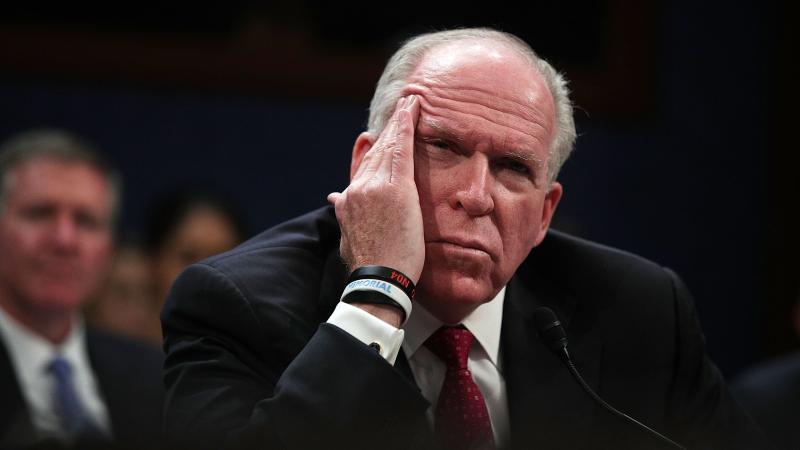
DOJ officials are also preparing to issue multiple grand jury subpoenas relating to an investigation into former CIA Director John Brennan tied to his handling of British ex-spy Christopher Steele’s discredited dossier and his involvement in the politicized intelligence community assessment on the 2016 election, Just the News has been told.
A grand jury has been empaneled in South Florida to handle investigations into the Russiagate saga, sources familiar with the inquiry who declined to be named due to the sensitive nature of the investigation told Just the News, and Brennan is being closely scrutinized.
Expectations, leaks, and "Burn Bags"
The subpoenas are being sent out as new revelations indicate that Comey, who was indicted earlier this year in Virginia, expected former Secretary of State Hillary Clinton to emerge victorious in 2016, that the ex-FBI director was aware of the so-called Clinton Plan intelligence wrongly linking Trump to Russia in that election, that key information on Crossfire Hurricane and other FBI investigations was hidden in burn bags at FBI headquarters, and that his friend and lawyer Daniel Richman allegedly leaked to the media despite FBI guidelines warning him not to.
Comey is charged with making false statements and obstructing Congress concerning testimony in 2020 in which he stood by earlier 2017 testimony saying he did not approve of anonymous leaks to the news media on high-profile cases involving Clinton's emails and Donald Trump's now-debunked ties to a Russian plot to influence the election. He has pleaded not guilty.
Comey, fired as FBI director in 2017 by President Trump, oversaw both the politicized investigation into Clinton's illicit use of a private email server to send classified information and the baseless Trump-Russia collusion inquiry.
Comey expected Clinton to win in 2016, according to newly-unearthed emails he sent to Richman.
Then-DOJ watchdog Michael Horowitz’s 2018 report criticized the FBI’s Midyear Exam investigation into Clinton’s illicit use of a private email server to send classified information while she was Secretary of State, concluding Comey’s actions were “extraordinary and insubordinate” when he announced Clinton wouldn’t be charged in a speech on July 5, 2016.
Comey had said in the speech that Clinton’s email practices were “extremely careless” but that he also allegedly believed “no reasonable prosecutor” would bring charges against her. Comey alerted Congress in October 2016 that further Clinton emails had been found on a laptop belonging to disgraced former Democratic Rep. Anthony Weiner, then the husband of top Clinton aide Huma Abedin. The files were on Weiner's laptop in a folder labeled "Life Insurance."
“Make sure you keep your eyes shut. The country can’t seem to handle your finding stuff,” Richman wrote to Comey on Oct. 29, 2016. Comey replied: “Thanks for the battling you have done against unreason. This is a strange time. B[u]t we press on.”
Comey: "A president-elect Clinton will be very grateful"
The next day, Richman sent Comey an email about an opinion piece he had been asked to write for The New York Times about Comey’s letter to Congress. Richman stated that he was “not inclined” to “write something” but that he would “do it” if Comey thought it would “help things to explain that [Comey] owed [C]ong[ress] absolute candor” and that Comey’s “credibility w[ith] [C]ong[ress] w[ould] be particularly important in the coming years of threatened [C]ong[ress] investigations.”
“No need. At this point it would [be] shouting into the wind,” Comey said in his Oct. 30, 2016 response back. "Some day they will figure it out. And as [Individual 1 and Individual 2] point out, my decision will be one a president-elect Clinton will be very grateful for (although that wasn’t why I did it).”
The 2018 report by the DOJ watchdog uncovered evidence that the FBI had delayed following up on information about Clinton emails found on the Weiner laptop and that the delay may have come from the FBI’s desire to emphasize the baseless Trump-Russia collusion investigation over the Clinton emails scandal.
In 2016, since-fired FBI special agent Peter Strzok had exchanged a host of anti-Trump texts with former FBI lawyer Lisa Page, with whom he was having an affair. Horowitz wrote, “We did not have confidence that Strzok’s decision to prioritize the Russia investigation over following up on the Midyear-related investigative lead discovered on the Weiner laptop was free from bias.”
Despite going after Clinton for her improper use of a private email server, Comey himself was using a personal and anonymous Gmail account to discuss FBI matters with Richman.
Comey’s own notes indicate he knew about Clinton Plan Intelligence
The DOJ also showed on Monday that, despite Comey telling Congress he didn’t recall this, he had taken handwritten notes in September 2016 indicating he had indeed been briefed on the Clinton Plan Intelligence indicating Clinton’s 2016 campaign planned to tie Trump to Russia.
Special Counsel John Durham’s 2023 public report revealed that “the Intelligence Community received the Clinton Plan intelligence in late July 2016.” The Durham report showed that Comey was briefed on the Clinton Plan intelligence by then-CIA Director John Brennan in early August 2016 and was also sent a CIA referral memo about the Clinton Plan intelligence in early September 2016.
This intelligence related to an alleged plan by the Clinton campaign to link Trump to Russia and Vladimir Putin in an effort to distract from her private email server scandal.
Nevertheless, Comey told the Senate Judiciary Committee in late September 2020 that he did not recall this bombshell referral memo from the CIA. The Trump DOJ’s efforts to indict Comey over that piece of his testimony failed.
“An additional record discovered as part of this management review process was an original referral by the Central Intelligence Agency to former FBI Director James Comey,” the FBI’s newly-unearthed launch document said.
The counterintelligence operational lead was dated Sept. 7, 2016 and was “believed to have been missing for years,” the FBI said, with agents writing that it was found “in a storage closet adjacent to the Director’s office.”
The DOJ wrote that “inside a locked safe within Room 9582, investigators located copies of handwritten notes of the defendant when he was the Director of the FBI.”
The prosecutors added that Comey’s handwritten notes “were not known to any prior investigative teams.”
Key documents about Crossfire Hurricane, John Durham, J6, all hidden in "Burn Bags"
Patel told Just the News on Tuesday that “we have found several bags containing critical evidence on Russiagate and the Durham annex, and declassified them to show the truth about James Comey and other senior leaders' actions during the disgraceful Crossfire Hurricane scandal.”
The FBI’s launch document for investigating the burn bag saga, originating with the FBI Criminal Investigative Division’s Public Corruption and Civil Rights Section, is dated July 21, 2025.
FBI agents said they had made a “request to open and assign a Preliminary Investigation to investigate the activities or involvement of current and/or former FBI employees for potential violations of Title 18 U.S.C. 2071, Concealment, Removal, or Mutilation Generally, and/or other related offenses, between July 1, 2016 and the present day.”
The FBI document states that, in mid-April, “the Director’s Advisory Team was informed of the unusual discovery of highly classified and sensitive documents found inside five ‘burn bags’ located in Room 9582, a certified Sensitive Compartmented Information Facility (SCIF) at the FB Headquarters building in Washington, DC.”
The FBI said the documents that were unearthed included classified documents inside burn bags “which appeared to have been placed in the SCIF around the timeframe of the 2025 presidential inauguration — Friday, January 17, 2025, through Wednesday, January 22, 2025.” The bureau agents wrote that the documents were “presumably intended for destruction”
The discovery led to an “internal management review” to determine if there was a “legitimate purpose” for the documents being there and to figure out the “underlying motivation” for it, the FBI launch document said.
“Among the records found were many related to the FBI’s raid on Trump's Palm Beach residence, Mar-a-Lago, the January 6 Capitol breach, the Crossfire Hurricane investigation, as well as a copy of the Classified Appendix to the John Durham Special Counsel investigation,” the FBI said.
Comey authorized Richman to leak in 2016 to "correct" stories critical of him
Richman, a former DOJ official and current Professor of Law at Columbia University Law School, was assisting the FBI during the 2016 election. It is already public knowledge that Richman later assisted Comey by leaking the so-called “Comey Memos” to The New York Times in 2017 after Comey's firing by President Trump.
Richman previously admitted to agents in interviews that he routinely communicated on behalf of Comey, his longtime friend, with New York Times reporter Michael Schmidt, whose work was among the newspaper's 2018 Pulitzer-winning stories on alleged Russian election interference. The goal, Richman told the FBI, was "to correct stories critical of Comey, the FBI and to shape future press coverage" outside the bureau's official press office, according to internal FBI memos.
"Richman was pretty sure he did not confirm the Classified Information. However, Richman told the interviewing agents he was sure 'with a discount' that he did not tell Schmidt about the Classified Information," one FBI memo recounted.
The DOJ’s Monday filing said the emails showed Comey was aware of and was encouraging Richman's contacts with the media, contrary to his claims to Congress.
"Consistent with the above-described correspondence, Richman corresponded extensively with members of the media regarding or on behalf of the defendant, including in an anonymous capacity," the DOJ court filing argued.
“When I read the times [New York Times] coverage involving [Reporter 1], I am left with the sense that they don’t understand the significance of my having spoke about the case in July [2016]. It changes the entire analysis. Perhaps you can make him smarter,” Comey told Richman on Nov. 1, 2016.
Richman responded the next day, saying: “This is precisely the case I made to them and thought they understood. I was quite wrong. Indeed I went further and said mindless allegiance to the policy (and recognition that more evidence could come in) would have counseled silence in july to let hrc [Hillary Clinton] twist in the wind.”
Richman soon added, “Just got the point home to [Reporter 1]. Probably was rougher than u would have been.”
Comey then emailed Richman shortly thereafter, saying “pretty good” and sending a link to a New York Times piece about Comey’s alleged options in late October 2016 concerning the Clinton email investigation. Comey told Richman, “Someone showed some logic. I would paint the cons more darkly but not bad.” Richman then responded: “See I *can* teach.”
Richman knew not to leak — but allegedly did anyway
Just the News reported that Richman initially signed paperwork in 2015 acknowledging ethics guidelines which would have barred him from misusing government information and from making non-public information public to further anyone’s private interests.
Richman signed an SGE appointment document on June 30, 2015. It included the acknowledgment of ethics guidelines. The Office of Government Ethics guideline document referenced in the document signed by Richman was titled, “To Serve With Honor. A Guide on the Ethics Rules That Apply to Advisory Committee Members Serving as Special Government Employees" (SGE's).
At Comey’s direction, records previously showed Richman allegedly spoke with the press to help shape news stories in Comey’s favor, although Richman has claimed Comey never asked him to talk to the press.
FBI emails show that Richman was ostensibly working at the FBI for the Office of General Counsel under then-FBI general counsel James Baker, and that Richman was coordinating with Baker and with then-Comey chief of staff James Rybicki.
Richman's record not the clearest in government employment
Internal FBI emails released through the Freedom of Information Act show that, while Richman signed a June 2015 acknowledgment related to his appointment to be an SGE, his first term appeared to have officially lapsed at the end of June 2016. The paperwork for Richman to re-sign to have him continue as an SGE does not appear to have been sent to Richman again until December 2016, and FBI emails indicate that Richman never actually signed it despite having been reappointed as an SGE in 2016.
During this timeframe, Richman continued meeting with Comey and communicating with FBI officials. Comey’s friend resigned as an SGE in early February 2017.
The ethics guidelines included the following admonishment: “Don’t misuse Government information. If you get information that has not been made available to the general public, don’t use (or allow the improper use of) that nonpublic information to further any private interest, either your own or another’s.”
Richman was also reportedly sent guidelines in January 2017 which said SGE's could not improperly leak government information for anyone’s private gain.
Brennan also under the microscope
John Durham’s investigation as special counsel passed on prosecuting Brennan as well as a host of other key Russiagate figures, but the Justice Department under Attorney General Pam Bondi seems like it may be considering doing so.
Just the News previously reported that CIA Director John Ratcliffe sent a criminal referral on Brennan to the FBI in July related to the ICA on the 2016 election, with the CIA chief tweeting that “the 2016 IC Assessment was conducted through an atypical & corrupt process under the politically charged environments” under Brennan and fired FBI Director James Comey, who is currently being prosecuted for allegedly lying to Congress when he denied authorizing leaks to the media about the FBI’s Clinton investigation in 2016.
Director of National Intelligence Tulsi Gabbard also sent declassified evidence to the DOJ in July on what she dubbed a “treasonous conspiracy” related to top U.S. intelligence officials during the Obama administration allegedly politicizing intelligence related to Russia and the 2016 election, Just the News had also reported.
The GOP-led House Judiciary Committee also sent Bondi a criminal referral last month, arguing that “Brennan falsely denied that the CIA relied on the discredited Steele dossier in drafting the post-election Intelligence Community Assessment” and that “Brennan falsely testified when he told the Committee that the CIA opposed including the Steele dossier in the ICA.”
“I have cooperated with all these inquiries and investigations,” Brennan told MSNBC in October. “I have explained exactly what transpired during the Russian interference in the 2016 election, and Jim Jordan now, I think, is trying to twist my words and misrepresent and mischaracterize the facts as a way to play to and be a supplicant to Donald Trump.”
Brennan, Steele, and the ICA
Ratcliffe's referral to Patel is related to possible criminality by Brennan, sources familiar with Ratcliffe's actions told Just the News, following a review by the CIA released this summer.
The CIA’s “lessons learned" review of the 2016 ICA — which was released in January 2017 — sharply criticized Brennan for joining with anti-Trump forces in the FBI in pushing to include Steele’s baseless anti-Trump dossier in the assessment. In Ratcliffe's review, the CIA also critiqued the “high confidence” assessment by the FBI and the CIA that Russian leader Vladimir Putin had “aspired” to help Trump win in 2016.
While the specifics of Ratcliffe’s criminal referral of Brennan to the FBI have not been made public, it is likely that it has to do with Brennan’s potentially false statements to Congress about the ICA and the Steele dossier. Brennan spoke with Durham in August 2020 and testified before the House Judiciary Committee in May 2023. Given a five-year statute of limitations, he could be in the crosshairs of law enforcement action until May 2028.
Lying to Congress can be a federal crime under 18 U.S.C. §1001, which forbids making false statements to any branch of the federal government. The statute of limitations of five years starts to run when the crime is completed, which is when the false statement is made or the false document is submitted.
It is unclear what exactly Brennan may have told Durham about his role with the ICA and the Steele dossier, because the transcript of Brennan’s August 2020 interview with Durham's team has not been made public. It is apparent from statements made by Brennan's spokesman and his lawyer that the ICA and Steele dossier came up during Brennan’s interview with Durham, despite quotes from that portion of Brennan’s interview not making it into the Durham report. Brennan’s testimony to Durham could be key in Bondi’s decision making.
Brennan downplays the Steele Dossier
Brennan testified before the House Judiciary Committee in May 2023, where he was mostly questioned about his role as one of the 51 former intelligence officials who signed the infamous Hunter Biden laptop letter in October 2020. But during the questioning, Brennan was also forced to talk about the ICA and the Steele Dossier. That testimony is likely to be scrutinized by Bondi’s team, and fall inside the reach of criminal law's limitation period.
Brennan signed onto the October 2020 letter attempting to discredit New York Post stories about Hunter Biden’s laptop, with the ex-spies baselessly arguing that the Russians were involved with the laptop.
It was later revealed by the GOP-led House Judiciary Committee that former acting CIA Director Michael Morell wrote the laptop letter after being “prompted” by future Secretary of State Antony Blinken to put the letter together, and that the debunked laptop letter was written to give Joe Biden a “talking point” in his debate with Trump ahead of the November 2020 election.
Brennan had claimed to Congress that “I was not involved in analyzing the dossier at all. I said the first time I actually saw it, it was after the election. And the CIA was not involved at all with the dossier. You can direct that to the FBI and to others.” Brennan said he was aware of the FBI’s involvement with the Steele Dossier “because there's an annex in the ICA, the Intelligence Community Assessment, that the Bureau asked to be included in there. It was their purview, their area, not ours at all.”
“I received a copy of it from the FBI when they were wanting to have a summary of that document put into the — or, attached to the Intelligence Community Assessment that was done. … And the CIA was very much opposed to having any reference or inclusion of the Steele Dossier in the Intelligence Community Assessment,” Brennan said. “And so they sent over a copy of the dossier to say that this was going to be separate from the rest of that assessment. And that's when the CIA was given formal access to it.”
The former CIA director said “no” when asked if he edited the ICA, and said “yes” when asked if he was aware of dissenting opinions about the conclusions of the ICA.
“There were individuals who had read the document within CIA who were not involved in the drafting or the analysis [who disagreed with the ICA conclusions],” Brennan said. “And so I listened to some of their concerns, but I deferred to the experts: the Russian, the counterintelligence, the cyber experts, and the analysts who actually drafted this. And so I did not overturn or change any of the judgments and language in that document.”
Brennan wanted the dossier in the 2016 intel assessment
The largely declassified CIA review released by Ratcliffe this summer focused on the ICA about Russia and the November 2016 election. It was put together by the CIA's Directorate of Analysis at Ratcliffe’s direction and concluded that “the decision by agency heads to include the Steele Dossier in the ICA ran counter to fundamental tradecraft principles and ultimately undermined the credibility of a key judgment.”
The agency review memo also stated that the CIA’s Deputy Director for Analysis warned in a late December 2016 email to Brennan that including the dossier in any form risked “the credibility of the entire paper.”
The review by the CIA also revealed that “despite these objections, Brennan showed a preference for narrative consistency over analytical soundness” and that “when confronted with specific flaws in the [Steele] Dossier by the two mission center leaders – one with extensive operational experience and the other with a strong analytic background – he appeared more swayed by the Dossier's general conformity with existing theories than by legitimate tradecraft concerns.”
The CIA review memo stated that Brennan ultimately formalized his position in writing, arguing that “my bottomline is that I believe that the information warrants inclusion in the report.”
Steele, a former MI6 agent, had been hired in 2016 by the opposition research firm Fusion GPS, which was being paid by Clinton campaign lawyer Marc Elias. The dossier, now discredited, was used by the FBI to obtain FISA warrants against a Trump campaign official, and evidence continues to emerge about how it was included in the ICA on Russia and the 2016 election.
Comey and former FBI Deputy Director Andrew McCabe had pushed in December 2016 to include British ex-spy Christopher Steele's debunked dossier in the 2016 ICA on alleged Russian meddling. The recent CIA review also sharply criticized Brennan for allegedly joining with these anti-Trump forces in the FBI in pushing to include Steele’s baseless anti-Trump dossier in the assessment.
Steele Dossier underpinned key judgment in the ICA, despite Brennan's denials
A years-old analysis from the GOP-led House Intelligence Committee — declassified this summer — provided further detail on how Brennan ensured the Steele Dossier would be included in the ICA, despite objections from others at the CIA. The report stated that “the DCIA rejected requests from CIA professionals that the dossier be kept out of the ICA.”
The House report cited a senior intelligence officer present at a meeting with Brennan where “two senior CIA officers — one from Russia operations and the other from Russia analysis — argued with DCIA that the dossier should not be included at all in the ICA, because it failed to meet basic tradecraft standards.”
The same officer said that Brennan refused to remove the reference to the dossier and, when Brennan was confronted with the dossier's significant problems, said that Brennan reportedly replied, "Yes, but doesn't it ring true?"
It was revealed by Just the News that the recently-declassified House Intelligence Committee report alleged that the Obama-era intelligence assessment on Russian election meddling used the discredited Steele Dossier to underpin its conclusion that Putin aspired to help Trump win the 2016 election, directly challenging the testimony of officials like Brennan, who denied that that had happened.
The recently-declassified analysis states that “contradicting public claims by the DCIA [Brennan] that the dossier ‘was not in any way’ incorporated into the ICA, the dossier was referenced in the ICA main body text, and further detailed in a two-page CIA annex.”
Obama scrutinized alongside Brennan
Brennan and other collaborators on the ICA have steadfastly denied wrongdoing and suggested any criminal probe now would be politically motivated.
“There is irrefutable evidence that details how President Obama and his national security team directed the creation of an intelligence community assessment that they knew was false,” Gabbard also asserted from the podium at the White House press briefing room in July. “They knew it would promote this contrived narrative that Russia interfered in the 2016 election to help President Trump win, selling it to the American people as though it were true. It wasn’t.”
A spokesperson for Obama released a statement in response to Gabbard’s allegations, where he sought to deny Gabbard’s claims.
“Out of respect for the office of the presidency, our office does not normally dignify the constant nonsense and misinformation flowing out of this White House with a response. But these claims are outrageous enough to merit one,” the Obama statement read. “These bizarre allegations are ridiculous and a weak attempt at distraction.”
Obama made public statements as early as mid-December 2016 indicating that he was endorsing a predetermined CIA view about Putin allegedly wanting Trump to win and Clinton to lose, even though the ICA had not even been completed and was still being debated and drafted at the time.
Just the News revealed that the ICA also contained a recently-declassified claim that the Kremlin “historically” preferred Republican candidates over Democratic ones — something belied by the actual historical record.
It was further revealed by Just the News that the controversial ICA on meddling in the 2016 election was supposed to include details on Chinese hacking efforts targeting U.S. presidential campaigns in 2008 and 2012 — but it focused solely on Russia instead, and never mentioned Beijing once.
Just over a decade ago, the Brennan-led CIA was publicly accused of spying on the Senate Intelligence Committee in 2014, a claim Brennan would repeatedly deny, despite evidence to the contrary. It remains to be seen whether Brennan will skate over what may be lies related to the 2016 ICA and the Steele dossier in the same way he managed to dodge accountability for the CIA’s snooping on the Senate.
The Facts Inside Our Reporter's Notebook
Links
- expected
- aware
- burn bags
- leaked
- warning
- report
- tarmac meeting
- response
- the FBI's desire
- showed
- Clinton Plan Intelligence
- revealed
- failed
- wrote
- added
- told
- launch document
- Title 18 U.S.C. 2071
- Columbia University Law School
- public knowledge
- friend
- admitted
- piece
- records previously showed
- said
- released
- SGE
- revealed
- signed
- titled
- guidelines


Top Stories

Trending
Just the News Spotlight
Just News, No Noise