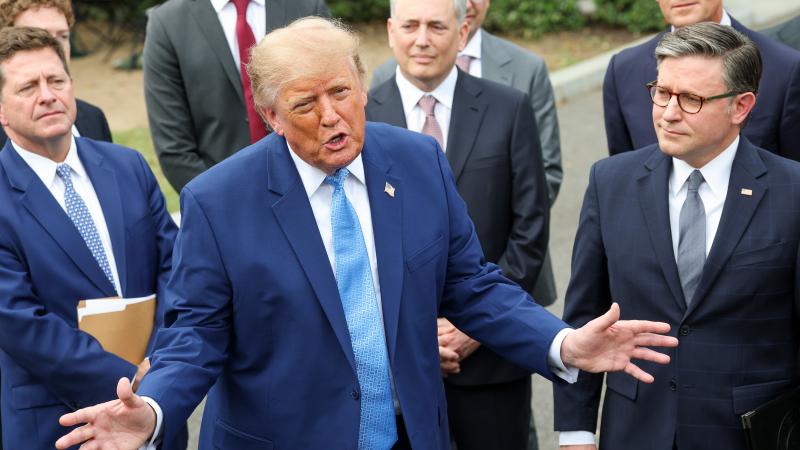
Supreme Court to hear arguments in high-profile case on Trump’s effort to end birthright citizenship
President Trump's executive order instructs agencies not to recognize U.S. citizenship for children born on or after February 19, 2025.
The Supreme Court is set to hear oral arguments on Wednesday in Trump v. Barbara, one of the most consequential constitutional cases in decades. At issue is President Donald Trump’s Executive Order 14160, signed on his first day back in office, directing federal agencies to deny automatic citizenship to certain children born in the United States.
The Executive Order
The executive order instructs agencies not to recognize U.S. citizenship for children born on or after February 19, 2025, if (1) the child’s mother is “unlawfully present” in the U.S. or holds only temporary protected status, and (2) the father is neither a U.S. citizen nor a lawful permanent resident.
The order represents the most direct executive challenge to birthright citizenship in modern American history. The administration says the policy targets so-called “birth tourism” and seeks to tighten immigration enforcement without congressional action.
The Plaintiffs and Lower Court Rulings
The lead plaintiff, proceeding under the pseudonym “Barbara,” is a Honduran asylum seeker who gave birth in the United States. She and similarly situated families filed a class-action lawsuit in the U.S. District Court for the District of New Hampshire, arguing that the executive order violates the Citizenship Clause of the U.S. Constitution as well as the Immigration and Nationality Act (INA.)
The district court quickly issued a nationwide preliminary injunction in July 2025, blocking enforcement of the order. It found that the plaintiffs are likely to succeed on the merits of their claims.
The government sought certiorari before judgment at the U.S. Supreme Court. Subsequently, the U.S. Court of Appeals for the First Circuit unanimously held that the executive order violated both the Citizenship Clause and the INA. Every other court to address the executive order has enjoined its enforcement.
Arguments
Represented by ACLU National Legal Director Cecillia Wang, the respondents argue that the order directly contradicts the plain text of the 14th Amendment, which provides:
“All persons born or naturalized in the United States, and subject to the jurisdiction thereof, are citizens of the United States and of the State wherein they reside.”
They rely heavily on the Supreme Court’s 1898 decision in United States v. Wong Kim Ark, which held that a child born in San Francisco to Chinese immigrant parents (who were not U.S. citizens and were subject to the Chinese Exclusion Act) was still a birthright citizen.
The challengers contend that “subject to the jurisdiction thereof” excludes only narrow categories like children of diplomats or invading enemy forces – not children of immigrants or undocumented residents who are otherwise obligated to obey U.S. laws.
Solicitor General John Sauer will argue for the government.
The administration’s briefs assert that the original public meaning of the Citizenship Clause, rooted in English common law and the post-Civil War context, requires complete political allegiance rather than mere physical presence.
The administration maintains that individuals who are unlawfully present or hold only temporary status are not fully subject to U.S. jurisdiction in the constitutional sense. It also argues that Wong Kim Ark is distinguishable because the parents in that case were lawful residents.
Potential Stakes
This case arrives amid intense national debate over immigration, executive authority, and constitutional interpretation. It has attracted a record volume of amicus curiae briefs from historians, constitutional scholars, states, foreign governments, and advocacy groups on both sides.
A ruling in favor of the administration could affect hundreds of thousands of children born since the order’s issuance and potentially cast uncertainty over the citizenship status of millions more Americans whose parents were not citizens or permanent residents at the time of their birth.
Critics warn it could create stateless children and upend a core principle that has defined American identity for generations.
The case has drawn widespread attention and amicus briefs from across the political spectrum.
Supporters of the executive order argue it closes loopholes in immigration policy, while opponents, including Bruce Springsteen (who authorized use of “Born in the U.S.A.” in an ACLU ad campaign), frame it as an attack on foundational American values.
The outcome could fundamentally reshape immigration law, as well as the balance of power between the executive branch and Congress on defining citizenship, with ripple effects for families, public benefits, and national identity.
How to Listen
Oral arguments begin at 10 a.m. EDT on Wednesday, April 1. The birthright citizenship case is the only case the Court will hear that day.
A decision is expected by late June or early July.
However the Court rules, the outcome is likely to rank among the most consequential decisions in modern Supreme Court history – shaping not only immigration law, but the constitutional definition of who counts as an American.


Top Stories


Trending
Just the News Spotlight
Just News, No Noise