Related Articles



The Pentagon's inspector general says Operation Epic Fury has cost at least $33.4 billion, paid for out of accounts meant to train and maintain the military.
Congress never approved a dollar specifically for the war with Iran. Yet the Pentagon's inspector general says Operation Epic Fury has cost at least $33.4 billion, paid for out of accounts meant to train and maintain the military.
The $33.4 billion figure, disclosed in the first inspector general report on the operation, covers the period through June 30 and excludes infrastructure repairs and economic fallout. A separate estimate released Tuesday by the Congressional Budget Office put the Pentagon's cost at $38.1 billion through Aug. 1, and found the war is running $2 billion to $3 billion a month as it continues. Both figures are below the $67.1 billion in supplemental funding the White House requested for the Department of War, although CBO found only $42.3 billion of that request was directly related to the conflict.
With no dedicated appropriation, the services have paid for the war by dipping into their base budgets, the day-to-day accounts that fund training, maintenance and equipment upkeep, while the Department of War, as the Pentagon is now formally known, waits on a $67.1 billion supplemental request the White House sent Congress on June 24 that includes funding for the conflict and broader defense priorities. To bridge the gap, the department has asked to move money between accounts, a step defense budget analysts say will likely delay weapons modernization.
Part of the request is invisible even to the taxpayers footing it. The June 24 letter set aside $12.1 billion for unspecified classified programs, a line larger than the fuel, drone and readiness requests combined. It is one of just three line items, alongside $21 billion for munitions and $17.3 billion in operational costs, that together total $50.4 billion, or 68% more than the roughly $30 billion the administration's own budget director, Russell Vought, told Congress the conflict had cost as of late June.
The budget office reached its estimate without the Pentagon's help. The agency reported that the Department of War "did not respond to CBO's requests for information," leaving analysts to rely on public data. CBO found that only $42.3 billion of the $67.1 billion request was directly related to the conflict, and noted that earlier wars in Iraq and Afghanistan "have not included such a large proportion of classified funding."
The trade-offs are already showing up, said Elaine McCusker, a senior fellow at the American Enterprise Institute and a former acting Pentagon comptroller. While it waits for supplemental relief, she said, the department is covering costs through reprogramming requests that will "likely cause modernization delays," and by "deferring or delaying activities funded" by operations and maintenance funds, including facilities maintenance, depot repairs and, likely, some training. A 72-day stopgap spending measure set to take effect Oct. 1, at levels below current budgets, "could make the entire situation worse, and ultimately more expensive," she told The Center Square.
The Center Square asked the department in writing why the operation is being funded from base accounts without a dedicated appropriation, and what modernization would be deferred as a result. A senior War Department official did not address those questions but disputed the inspector general's findings more broadly, saying the office "did not have access to all relevant information" and calling any suggestion that U.S. munitions are depleted "completely false." The Pentagon's inspector general, however, reported that the operation "resulted in strategic inventory shortfalls and revealed industrial base bottlenecks for munitions resupply," quoting the department's acquisition and sustainment office.
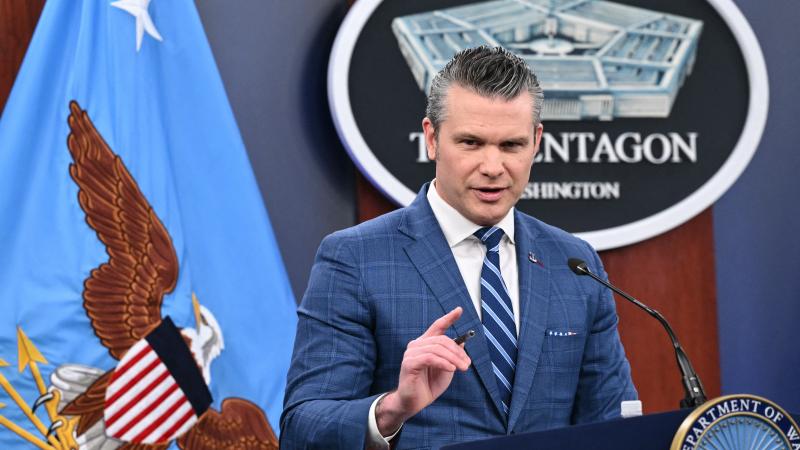
Cost estimates have climbed across successive hearings, from $25 billion in April to $29 billion in May to $37.5 billion when Secretary of War Pete Hegseth testified before the Senate Appropriations Committee on July 21. Separately, AEI analysts tracking incremental military costs since December estimated U.S. military operations in the Middle East and Caribbean had cost $67.7 billion this fiscal year.
Democrats on the Appropriations Committee argued the department does not need the money. Sen. Patty Murray, the panel's vice chair, said the department "sits on over $100 billion in unspent funding" from an earlier reconciliation bill. Separately, Sens. Dick Durbin, Jeanne Shaheen and Chris Coons pressed Hegseth on why he was seeking another $67 billion while roughly $75 billion from an earlier reconciliation package remained unobligated. Hegseth said that money was already committed to rebuilding priorities the previous administration had neglected, including the Golden Dome missile-defense program and hypersonics, and that redirecting it would be "robbing Peter to pay Paul." He said 95% of those reconciliation funds would be allocated by the end of September.
Congress has still not approved the $67.1 billion request. A stopgap measure signed Sept. 2 funds the government through Dec. 11 at roughly current levels, leaving the Pentagon to keep covering the war from existing accounts. As of late August, the inspector general counted at least 18 U.S. service members dead, and the cost estimates were still climbing.