Related Articles

The legal challenge centers on the procedures used to keep Essayli in office without U.S. Senate confirmation, which is generally required for U.S. attorneys.
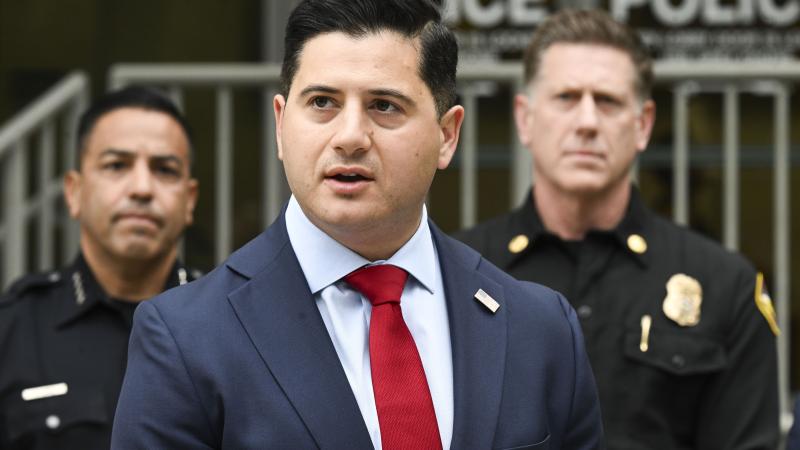
A federal judge has declined to pause an earlier ruling that found Bill Essayli is unlawfully serving as the top federal prosecutor in Los Angeles.
That sets the stage for the removal of Essayli from two criminal cases next Monday unless an appellate court intervenes.
Senior U.S. District Judge J. Michael Seabright rejected a request from the U.S. Department of Justice to stay his October order. Seabright ruled the government failed to demonstrate it would suffer specific harm and faces a low likelihood of success on appeal to the San Francisco-based 9th U.S. Circuit Court of Appeals.
While DOJ attorneys argued the legal dispute could potentially affect up to 5,000 prosecutions, Seabright dismissed the projection as an unsupported assertion.
The legal challenge centers on the procedures used to keep Essayli in office without U.S. Senate confirmation, which is generally required for U.S. attorneys. After reaching a 120-day statutory limit as interim U.S. attorney in 2025, Essayli resigned from the post. Then-Attorney General Pam Bondi subsequently appointed him as a "special attorney" and "first assistant U.S. attorney," an arrangement that allowed Essayli to continue leading the office without a Senate confirmation vote.
Seabright’s decision aligns with a recent ruling by the 9th Circuit that invalidated a similar appointment mechanism used in Nevada for prosecutor Sigal Chattah. Legal analysts have noted that the ruling could trigger broader challenges to Essayli's authority across other federal prosecutions in the Central District of California.
The Center Square reached out to Essayli, the White House and DOJ for comment, but did not receive a response.
Hans von Spakovsky, a senior legal fellow at Advancing American Freedom, criticized the judicial rulings and attributed the appointment disputes to confirmation delays in Congress.
"This would not be an issue if Democrats were not doing everything they could to prevent executive branch nominees from being confirmed and Senate Republicans had made that a priority," von Spakovsky told The Center Square in an email.
Looking ahead to the incoming Congress in 2027, von Spakovsky predicted further gridlock over DOJ nominations.
"With Democrats taking over in the Senate in January, I have no doubt they will do everything they can to prevent anyone from getting confirmed, particularly U.S. Attorneys, so they can hamper the ability of the Justice Department to do its job," he said. He added opponents aim to restrict enforcement of immigration laws and civil rights oversight in states such as California.
Von Spakovsky also argued that federal courts have applied inconsistent standards regarding unconfirmed DOJ officials across different presidential administrations.
"These judges seem to have partial amnesia," said von Spakovsky, who served as counsel to the assistant attorney general for civil rights at the DOJ from 2002 to 2005. "Vanita Gupta served as the unconfirmed assistant attorney general of the Civil Rights Division at DOJ for three years during the Obama administration. No judge ever questioned her position or her authority or the validity of lawsuits she authorized, including unjustified criminal prosecutions of abortion protesters under the FACE Act."
The dispute over the Trump administration's appointment authority is expected to reach the nation's highest court. The Trump administration has petitioned the U.S. Supreme Court to review the 9th Circuit's Nevada ruling, contending that federal statutes authorize the attorney general to delegate the powers of a vacant office in this manner. Essayli has similarly maintained that the Supreme Court will resolve the matter.