Related Articles



Analysis shows that Iran's inflation rate is the third highest in the world after Venezuela and North Korea, as pressure to resolve U.S.-Iran negotiations mounts
Iran’s year-over-year inflation has reached a record high, at levels just behind Venezuela and North Korea, according to a Johns Hopkins University professor, with the U.S.-Israel war now roughly three-months long with no clear end in sight.
Iran’s Central Bank released an official statement on Monday regarding the depreciation of its currency, the rial, which Iranians have been experiencing first-hand. Inflation for daily items such as medicine, taxi fares, tobacco and communication fees were up 113.8% from the same time last year.
The Central Bank also said that the consumer price index, a measure of a basket of goods and services, reached 77.2% in May in comparison to the previous year, with the rate 8.5% higher than April.
The rial, which used to be 32,000 to $1 in 2015, now sits at over 1.7 million to $1.
A private economic think tank based in Iran, the Bamdad Institute of Economic Studies, told the Associated Press that Iran’s inflation rates were at “an unprecedented rate since World War II," a statement that Iran's Central Bank has not acknowledged. During World War II, the British and Soviets had invaded the country, taken control of its railway, and upended its food supply, resulting in hyperinflation and famine.
Steve H. Hanke, a professor of Applied Economics at the Johns Hopkins University and member of the UAE Financial Advisory Council from 2008 to 2014, told Just the News on Wednesday the inflation rate in Iran right now is "117%/yr. That is the third-highest inflation rate in the world, behind Venezuela (596.97%/yr) and North Korea (198.3%/yr).”
Hanke bases his methodology for measuring inflation on a variation of purchasing power parity, a theory that he lays out in studies including The World Economics Journal.
Hanke also said that while Iran’s inflation is skyrocketing, the narrative that “the Iranian economy was in a state of collapse” before the war is “completely false,” as the only two Gulf countries with positive GDP/capita growth since 2008’s Great Financial Crisis were Iran and Saudi Arabia.
Still, the war in Iran was preceded by deadly street protests largely over high inflation and the collapse of the country's currency. They were the most intense protests since the Islamic Republic's 1979 revolution, and began in Tehran’s Grand Bazaar before reaching more than 400 cities. It followed the rial falling to the lowest levels – at roughly 1.4 million rials per U.S. dollar.
The Iranian theocracy killed over 7,000 people during the January protests, according to estimates by activists. Iran’s Ministry of Health also told TIME that the death toll could be as high as 30,000 on Jan. 8 and 9 alone, with state capacity to dispose of the dead and stocks of body bags exhausted, according to officials.
In 2017 and 2018, soaring food prices also galvanized protests which killed over 20 people, with hundreds arrested. In 2019, a government announcement raising subsidized gasoline prices sparked protests where over 300 people were killed.
“I have no doubt that if Trump leaves (Iran without a formal peace deal) ... most probably, we will see something like January by the end of summer because of the economic and social situations," analyst Mohsen Jalilvand said in a video published by Iran's Fararu news website.
The U.S. naval blockade of the Strait of Hormuz, which targeted crude oil exports, a key source of revenue, has also crippled Iran’s oil-backed economy, contributing to inflationary and currency pressures.
Iran’s Deputy Foreign Minister Kazem Gharibabadi said Thursday that it would seek to charge service fees for ships crossing the strait, through which about 20% of all oil and natural gas in the world passed before the war.
"I don't know where you're getting this perception that Iran is stronger. Iran has no navy left. They've lost a substantial percentage of their defense industrial base... and their economy is far worse today – and I mean far worse today – than it was six to nine months ago,” Secretary of State Marco Rubio said Tuesday before the Senate Foreign Relations Committee.
U.S. and Israeli airstrikes have also damaged Iranian industrial infrastructure and the oil sector, with local commerce continuing to struggle despite the April ceasefire, keeping state tax revenues critically low.
“We will definitely have higher prices," Iranian President Masoud Pezeshkian said in May. "We are fighting, and we must accept this hardship.”
At a Senate Finance Committee on Wednesday, Treasury Secretary Scott Bessent said that at present, Iranian inflation may be at more than 200%.
“Amid the impact of Economic Fury, Iran’s currency has hit an all-time low,” Bessent also wrote on X. “The Iranian people deserve a new era, which the corrupt and shambolic Iranian regime cannot provide.”
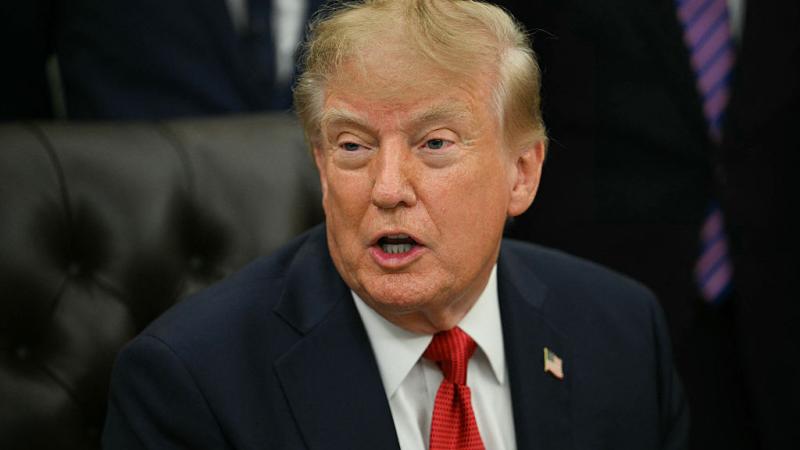
Meanwhile, negotiations between Iran and the U.S. are ongoing. President Donald Trump said Wednesday that talks with Iran could reach a conclusion over the weekend, telling reporters, "I hear the negotiation itself is going very well, actually. It might not happen ... It could happen over the weekend.”
The back-and-forth has been complicated by the Israel-Lebanon front, where Israel and Hezbollah exchanged strikes on Thursday, and Hezbollah rejected the terms of an Israel-Lebanon ceasefire agreement backed by the U.S. State Department.