California prepares for multi-billion dollar El Niño, Newsom calls this season strongest on record
It’s being called a “generational” El Niño this year because such intense weather events occur about once every 20 to 30 years. And in California, taxpayers could be stuck with cleaning up the multi-billion dollar impact.
(The Center Square) -
(The Center Square) - It’s being called a “generational” El Niño this year because such intense weather events occur about once every 20 to 30 years.
And in California, taxpayers could be stuck with cleaning up the multi-billion dollar impact.
The state government has been bracing for the anticipated impact of this year's El Niño weather pattern for months through disaster preparations and shoring up vulnerable regions. Researchers said the damage would likely cost in the billions of dollars despite the early efforts.
Gov. Gavin Newsom's office has called the El Niño season the strongest on record. And Climate Central, a policy nonprofit, noted that since 1980, major weather and climate disasters have cost more than $3.3 trillion.
Lilian Thaoxaochay, a disaster resiliency policy adviser for the University of California Agriculture and Natural Resources, told The Center Square that the state’s most recent El Niño, which took place during the 2023-24 winter, caused around $9 billion to $11 billion in damage, with similar damage likely for this year.
The Governor’s Office added that road fixes near Big Sur along the coastal Highway 1 had cost $312 million between 2020 and 2026, largely due to landslides, with fears of more to be caused by this year’s El Niño. In late October, Newsom signed an executive order aimed at protecting Highway 1 from landslides and other damage.
El Niño is a common weather pattern in the Pacific Ocean that occurs every few years, often with profound and global effects, Thaoxaochay said.
“That entails a lot of warm water from the Western Pacific, like over near Indonesia, kind of sloshing across the Pacific toward the coast of the Americas,” she added. “And because that warm water is carrying so much energy and moisture, it redistributes around the globe, where you see things like floods and droughts.”
But back in the Pacific Ocean, the temperature of the water plays a major part in the scale and size of an El Niño.
According to the National Oceanic and Atmospheric Administration, an El Niño year is when the eastern equatorial Pacific Ocean, an area off the coast of South America, is 0.5 degrees Celsius warmer than average. As of mid-October, the area had risen 3.35° Celsius above the 30-year average, according to the Climate Adaptation Center.
“Right now we're at 2.5° Celsius above normal, which puts us in that very strong El Niño category,” National Weather Service meteorologist Bryan Lewis told The Center Square Friday. Lewis, who works in the Los Angeles region, added that the commonly used term “Super El Niño,” is not scientifically used.
Climate researchers have emphasized that it can be difficult to know exactly how the weather will look during an El Niño year. While the formation is usually associated with heavy rain and subsequent floods, such as the most recent 2023-24 El Niño in California, other years have seen less rainfall than average, such as in 2015-16.
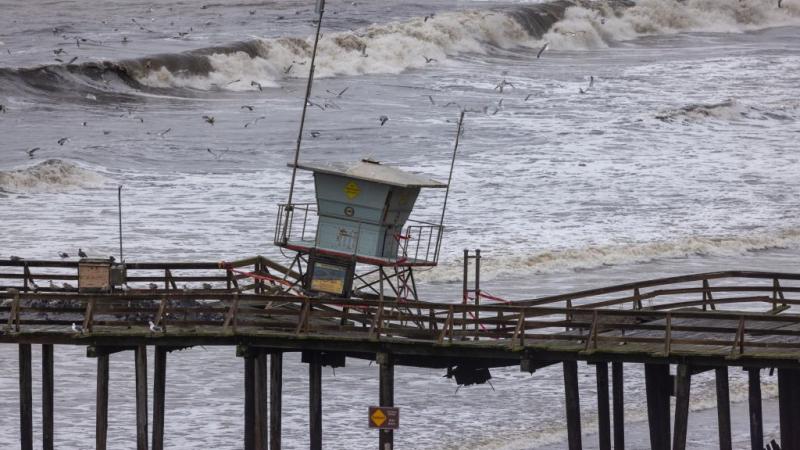
“We tend to see more coastal flooding, and that coastal flooding happens because that warm water sloshing our way actually raises sea level along the coast, so you don't need as much of a high tide to get a coastal flood,” said Dr. Kristina Dahl, vice president for science at Climate Central.
“We [also] tend to see more landslides, more coastal erosion, and because of the heavy precipitation, we tend to see more agricultural losses," the nonprofit's official said. "All of those things can have economic costs for the state as well as for taxpayers.”
Dahl added that the 1997-98 El Niño, one of the strongest on record, raised national food prices between 5-8%, largely due to flooding and storms in California. That year’s El Niño also caused a significant drop in tourism during spring in the region, but more snow at ski resorts.
Already, Californians have experienced the impacts of this year’s El Niño. NOAA this week reported 100-year record ocean water level highs in San Diego, La Jolla, Los Angeles and Santa Barbara, as well as far above average water temperatures.
The Governor’s Office and Public Utilities Commission of California did not give an answer when asked for a cost estimate of this year’s El Niño in the state. Instead, it pointed to a series of disaster preparation steps taken by Newsom over recent months, including a declaration of emergency in several counties from September.
Climate researchers supported the early preparations.
“Every dollar invested in preparedness saves $13 in recovery,” said Thaoxaochay, citing state data. She added that some advocates argued state preparations should have started even further in advance, given that the weather pattern was first noticed last fall.
While major climate events are often referred to as natural disasters, both Dahl and Thaoxaochay said this El Niño should most be associated with how it has been influenced by human-caused climate change.
"The baseline on which that natural process is happening is changing,” said Dahl. “And so part of what we're seeing with this year's El Nino, is it's expected to be one of the strongest events on record, but a part of that is the fact that the Earth has warmed so much. The oceans are so much warmer than they used to be because of climate change.”
“That’s not necessarily El Niño’s fault," Thaoxaochay said. "That comes down to man-made challenges."
The Facts Inside Our Reporter's Notebook



Top Stories





Trending
Just the News Spotlight
Just News, No Noise