Supreme Court hears oral arguments in campaign finance case
The NRCC, NRSC, Vice President JD Vance, and former Rep. Steve Chabot brought the case against the Federal Election Commission, arguing for the elimination of limits on coordinated spending
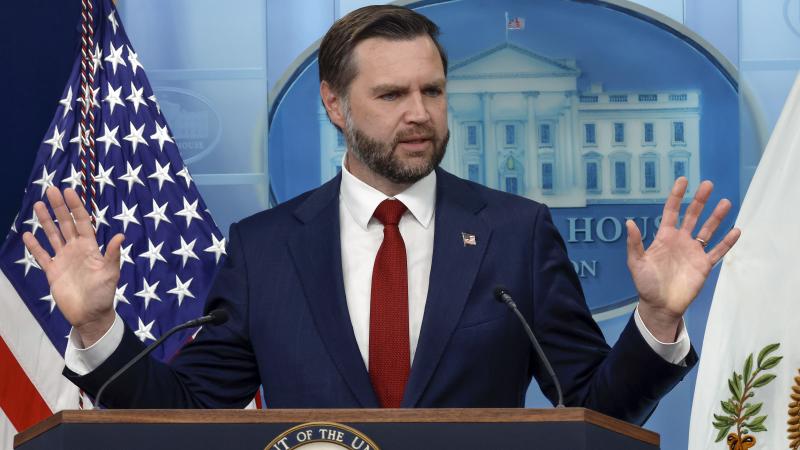
The Supreme Court on Tuesday heard oral arguments in a campaign finance case involving Vice President JD Vance and former Rep. Steve Chabot.
Vance, who was a senator when the case was filed, and Chabot, a fellow Ohio Republican, along with the National Republican Congressional Committee and the National Republican Senatorial Committee, brought the case against the Federal Election Commission, arguing for the elimination of limits on coordinated spending, ABC News reported.
Coordinated spending is the ability of political parties to more freely and directly finance TV ads and organizing efforts of candidates they favor.
The Republican parties in the case argue that limits on coordinated spending violate the First Amendment right to free speech.
"One of the key functions of a political party is to make sure that its candidates will vote for the party’s platform once in office," the Republican committees told the Supreme Court.
The Trump administration has declined to enforce or defend coordinated spending limits, resulting in the Democratic National Committee and a Supreme Court-appointed attorney arguing for preserving them.
"This has been held constitutional at least twice before by the Supreme Court and more times by lower courts," said Marc Elias, the Democratic election attorney defending the law. "The entire campaign finance system is built upon these limits."
In 1974, Congress set limits on the amount of money that U.S. individuals, organizations, and political parties can directly give to candidates, and the Supreme Court has previously upheld them as permissible protections against bribery in the electoral process.
Elias argued before the Supreme Court on Tuesday, saying that limits on coordinated campaign spending "do not pose any meaningful burden on party speech," NBC News reported.
"In fact, the vast majority of them hardly involve speech at all," Elias said. "The practical effect of petitioners' case would be to convert the political parties into mere paymasters to settle invoices from campaign vendors."
The NRSC's lawyer, Noel Francisco, told the Supreme Court in her argument that the campaign finance limits effectively limit free speech.
"I'm relying on the same free speech principles that, in the past, we and my friends on the Democratic side have been locked in arms on," Francisco said.
The Facts Inside Our Reporter's Notebook


Top Stories


Trending
Just the News Spotlight
Just News, No Noise