Trump hopes Xi, Putin meeting will bring progress on joint nuclear arms control
Navigating uncharted diplomatic waters, the historic trilateral summit aims to crack open nuclear arms control—even as experts caution that substance may take a backseat to theater. The top three superpowers' leaders have never met in one place: The 1945 Yalta conference is the closest historical analogy, and even that was before China overtook the UK in global influence.
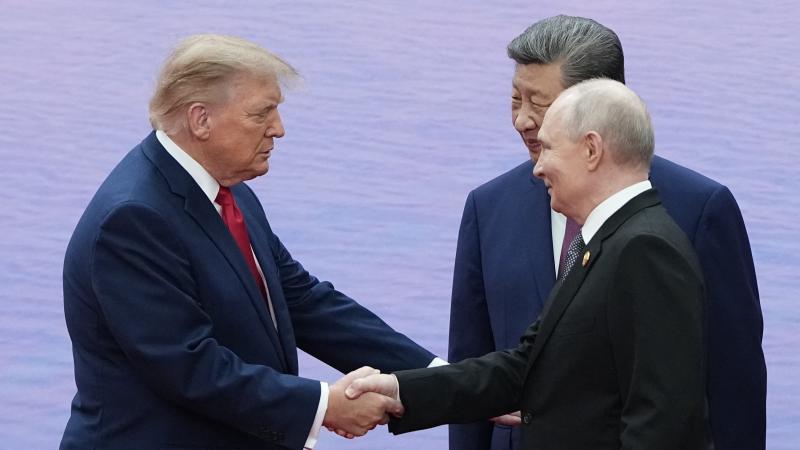
President Donald Trump's trilateral meeting with both Chinese President Xi Jinping and Russian President Vladimir Putin is historic. It is the first time the three leaders will meet together. The American president hopes the meeting will be the foundation for something even more historic, progress on joint nuclear arms control talks among the trio, a key goal of his second term.
The meeting comes on the sidelines of the Asia-Pacific Economic Cooperation summit in Shenzhen, China, the country’s technology hub, which preceded Trump's arrival in China on Wednesday.
The White House said that Trump plans to raise nuclear arms control with the leaders, heads of the world's two other major nuclear-armed powers. The American president has long sought to bring China into three-way arms control negotiations between the world’s leading nuclear powers, though Xi has been largely reluctant to do so.
Today's "theater" may lead to talks on a trilateral nuclear treaty
Experts told Just the News that the meeting is unlikely to produce any immediate results, but that it could open the door for the three powers to collaborate on a nuclear treaty in the future.
"It is again historic that we finally got the Chinese to sit down to the table, ostensibly with the Russians and us to talk about nuclear weapons, and it's something the Chinese have resisted,” said Brent Sadler, also of the Heritage Foundation.
Steve Yates, a Senior Research Fellow at the Heritage Foundation and former deputy national security advisor to Vice President Mike Pence, told Just the News that it is possible that Trump could “force a real conversation” on nuclear weapons, but that more likely it will be only diplomatic theater.
“They are the masters of theater and ceremony over substance,” Yates said of the Chinese in an interview with the Just the News, No Noise TV show.
“And so, he's taking the world leaders to a bright and shiny city to show off some tech things and development—it's not real China as I would call it, but it's theirs—and we're going to have some declarations,” Yates said.
“President Trump, when he said he wanted to talk about nuclear arms reduction, Xi Jinping and his staff basically said, ‘Well, not really that interested. We'd rather have some prepared statements exchanged for our summit.’ So President Trump doesn't follow the rules. Maybe he'll force a real conversation. But for now, I think […] our going-in assumption, it's theater first,” he added.
President Trump has made it a priority of his second term to engage with China in nuclear arms control talks. China tested its first nuclear bomb in 1964, but its stockpile remained much smaller than those of the United States and the Soviet Union during the Cold War.
Only in recent years has China begun rapidly growing its nuclear arsenal, under President Xi. The U.S. government now estimates that Beijing’s stockpile of atomic warheads will exceed 1,000 by 2030, up from around 200 only six years ago.
Shortly after his inauguration last year, Trump said he wanted both Russia and China to agree to “denuclearization.”
“Tremendous amounts of money are being spent on nuclear, and the destructive capability is something that we don't even want to talk about today, because you don't want to hear it. It's too depressing,” Trump said in an address to the Davos World Economic Forum in January 2025.
Trump: "It would be appropriate for the Chinese" to join a nuclear deal
“So we want to see if we can denuclearize, and I think that's very possible. And I can tell you that President Putin wanted to do it. He and I wanted to do it. We had a good conversation with China,” he added.
Earlier this year, as the New START nuclear treaty between Russia and the United States was set to expire, the president said he wanted to negotiate a new framework that would include China as well. “I think it would be appropriate for the Chinese” to join a nuclear deal, Trump told The New York Times in an interview.
However, China has resisted putting its nuclear arms buildup on the agenda of any negotiations. China’s Foreign Ministry said the country “always keeps its nuclear capabilities at the minimum level required for national security and has no intention of engaging in a nuclear arms race with any country,” The Wall Street Journal reported.
The three-way confab has already drawn comparisons to the 1945 Yalta Conference, where Franklin D. Roosevelt, Winston Churchill and Joseph Stalin shaped the post-World War II global order. Yates said this comparison is lacking, because Trump will not make concessions that will hurt U.S. interests in either region.
“But really, Yalta is largely seen as the great powers, after working together to defeat the Axis, carving up spheres of influence. That is definitely not what Trump, Putin and Xi would be doing. We're not going to cede the Asia Pacific to China,” Yates said.
“We just had a very powerful Quad meeting in Manila, where there's a big minerals deal and some other important statements that were made. That makes clear the United States is not forsaking the Indo-Pacific, and we're not giving Europe and Ukraine to Russia for free,” he added. “And so, regardless of what people's hiccups might be about how that's all been conducted, that's not Yalta 2.0.”
The Facts Inside Our Reporter's Notebook


Top Stories

Trending
Just the News Spotlight
Just News, No Noise