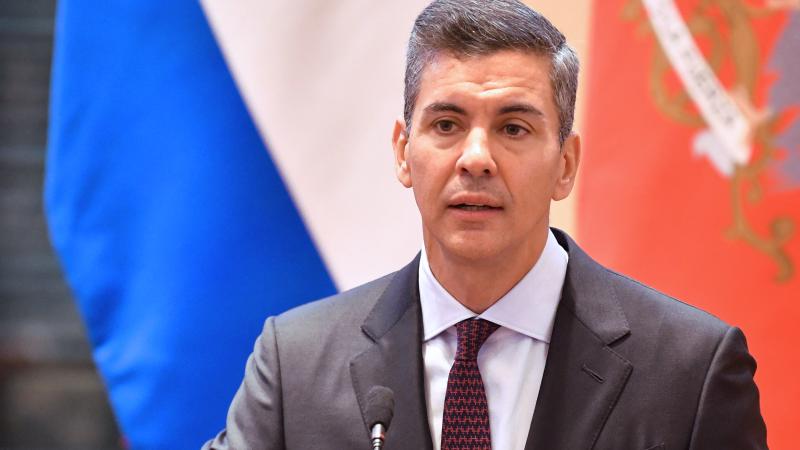
Trump finds no easy answers in ending Iran conflict after midterm rebuke
Experts urge maintaining maximum pressure and naval blockades rather than new strikes as Trump weighs options following midterm losses.
Ahead of the midterm rebuke of his party in Tuesday’s elections, President Donald Trump was reportedly considering ramping up strikes against Iran in an effort to break the logjam in the conflict. According to CNN, Iran's Supreme Leader Mojtaba Khamenei said anyone who believes the midterm results will shift US policy is “deeply mistaken.”
But, the cataclysmic results for his Republican Party, in part because of frustration among voters about how the war has resulted in higher gas prices, may prompt the president to reconsider his options moving forward, experts say.
Trump acknowledged on Wednesday following the results that the Iran war and its impact on gas prices played a role in the loss. He acknowledged the Iran war was “a piece of” the election dynamic but that he had no regrets about his decision to bomb Tehran and eliminate its nuclear capabilities.
Vice President JD Vance was even more direct. “The reason we lost is the war,” Vance wrote on X on Wednesday.
Trump: "If I had it to do again, I’d have to do it again, because long term, it’s the only answer.”
Asked about Vance’s assessment on Wednesday, Trump said it was “largely true because it drove the gasoline up a little bit short term.” He added: “But at the same time, if I had it to do again, I’d have to do it again, because long term, it’s the only answer.”
Experts told Just the News that, at this point, a renewed military campaign against Tehran would do little to change the overall trajectory of the war or push the country’s leaders into a final settlement with the United States.
Instead, they say that the president’s best course of action is to maintain his signature “maximum pressure” campaign against the regime until the economic pain spurs domestic instability that the Islamic Republic’s leaders cannot control.
The Trump administration has built up a comprehensive set of sanctions and an economic blockade against Tehran during the course of the war. The U.S. Navy has also disrupted Iran’s shadow fleet, which it previously used to transport sanctioned oil to customers in China—one of its major economic lifelines.
Miad Maleki, a senior fellow at the Foundation for Defense of Democracies, told reporters on a call on Thursday that renewed strikes would “delay the effect of [this] pressure campaign” that the United States is currently conducting against Iran.
Iran “can fight in many different fronts with the Saudis, with Israelis, with their proxies around the globe, but there’s one war that they can’t fight, and that’s a domestic conflict that is becoming more and more difficult for them to fight,” Maleki told reporters on a call on Thursday.
Other experts agreed. Behnam Ben Taleblu, the senior director of FDD’s Iran Program, said that further strikes would likely “not change the trajectory of the war.”
“A short, sharp strike would be leading with our chin because I don’t think fundamentally it would change the Iranian negotiating position at this point in time,” Taleblu told reporters. “I would say, hold the line.”
Taleblu said this would look like maintaining the “maximum pressure” campaign of sanctions against the Iranian regime and keeping the naval blockade in place that has strangled Iran’s oil exports.
The blockade is “making sure that its most important commodity, crude oil and some petrochemical derivatives, aren’t able to be exported,” Taleblu said. “This, plus sanctions, is a one-two punch.”
The Treasury Department continues to escalate the sanctions against Iran under a set of policy pushes dubbed Operation Economic Outcast and Economic Fury. On Wednesday, Treasury’s Office of Foreign Assets Control (OFAC) published an alert warning of designation penalties for participation in Iran’s shadow fleet operations.
Iran’s economy was already in crisis before the U.S. strikes began in February, Just the News previously reported, with persistent inflation, a collapsing currency and years of drought fueling the largest anti-regime protests in the Islamic Republic’s recent history. Only a violent crackdown by security forces ended the demonstrations.
Additionally, the U.S. naval blockade on Iran’s oil exports has deprived the regime of one of its last remaining external revenue sources. At the start of the conflict, Tehran sought to hold the Strait of Hormuz waterway hostage to damage the regional and global economy. But, the U.S. blockade and successful commercial vessel escort operation has blunted Iran’s ability to control the strait.
In the months before the midterm elections, Middle East oil exports had largely returned to pre-war levels while Iran’s remained stagnant, showing the regime’s ongoing attacks in the Strait of Hormuz aimed at pressuring its neighbors and the United States are no longer working.
Iran tries to assert leverage after midterms
Yet, Iran sees the midterm election results as a potential way out, especially if President Trump is encouraged to seek a deal that hands Iran a win.
“The process of the US's collapse has accelerated,” an account belonging to Iran's Khamenei posted to X on Tuesday.
Iran’s parliament speaker echoed the sentiments, saying, “Conscience or the cost of living, Americans said NO TO WAR, and we endorse this message. If the US govt betrays their public will to serve international paymasters and blackmailers, it will learn our NO comes with a Nightmare.”
Taleblu assesses, however, that “even surrender to the Islamic Republic today is escalatory,” because it would show Tehran that it can successfully resist U.S. pressure directly.
“Whether you like it or not, the United States is in a war today, and it is in a war that the Islamic Republic is keen to continue because this regime has survived,” he said.
The Facts Inside Our Reporter's Notebook

Top Stories




Trending
Just the News Spotlight
Just News, No Noise