Musk's solo industry seat on Air Force One signals Trump's tech reset with China
The chips at the center of this fight power the AI behind everyday tools such as search, banking and customer service. So who gets to use them, and on what terms, could shape whether those technologies are built on American terms or Beijing's.
When Air Force One touched down Wednesday in Shenzhen, Elon Musk was the only executive aboard. In May, President Trump flew to Beijing with a full boardroom, and the empty seats now show how quickly Washington's chip détente with Beijing has cooled.
"I am frustrated when President Trump made it very clear that China should not receive any Nvidia chips above H100s," Treasury Secretary Scott Bessent told CNBC last week. "And so any leakage is very frustrating."
Bessent then went further. "The real story here should be: Did Nvidia know their client, and was there a robust effort at Nvidia to make sure that there was no leakage," he said in the same interview.
The thinner delegation follows a week of upheaval in the chip world. Former Nvidia CEO Jensen Huang flew with Trump on Air Force One to Beijing in May, and his place on this trip was in doubt after he resigned amid news reports of an affair with a woman U.S. intelligence suspects of being a Chinese spy. The company at the center of the case, Singapore-based Megaspeed, is suspected of buying Nvidia chips for Southeast Asian data centers and routing them to China, and it reportedly traded more than $4 billion of them over two years. Megaspeed says it takes its export-control obligations extremely seriously.
The one CEO who did make the trip is no Huang critic. Musk is among more than 175,000 signers of a "Stand With Jensen" petition. Still, his solo seat still marks a shift: U.S. officials say Trump does not plan to raise the alleged spy case at Thursday's meeting with Xi Jinping.
Closing the back door
The administration's sharpest move came the day Trump left for Asia. On Nov. 16, Commerce's Bureau of Industry and Security issued an interim final rule aimed at a gap in chip controls: Chinese companies renting U.S.-designed computing power from data centers in third countries instead of importing the chips.
The rule was notably not Commerce's own work. The bureau said it was written by and at the direction of the Treasury Department and the National Security Council. Exporters now need a license to ship advanced chips to Brazil, Indonesia, Malaysia, Thailand and Singapore, and data centers already serving restricted customers have 90 days to get one.
The rule also has teeth. Commerce says it will watch for countries that tolerate evasion and weigh consequences such as import restrictions and new license requirements. Chinese AI firms were reportedly rushing to lock in overseas Nvidia capacity before it took effect. Beijing condemned the measures as overreach.
Nvidia walks away
Nvidia itself is retreating. On Tuesday, acting CEO Colette Kress said the company will no longer sell its H200 chips in China. The same day, Nvidia announced a board-level committee to oversee national security, export compliance and trade risk.
The financial blow had largely been absorbed already. Nvidia guided to $108 billion in quarterly revenue on a forecast that assumes no data-center revenue from China. That suggests the company had been preparing for this outcome before Huang left.
Trump's two-track approach
The president's own posture is more nuanced than a clean break. He has defended Huang and said he would welcome his return and argued that what Nvidia sold China was older technology.
"Selling the other chips is a good thing, not a bad thing," Trump said Monday.
That defense comes with a firm line on Nvidia's most advanced products. Trump has said the Blackwell chips should be reserved exclusively for American customers. He also told Hugh Hewitt the U.S. would be in "bad shape" if it lost its edge in artificial intelligence.
The White House is also pursuing a coalition strategy. Nine countries signed a U.S. declaration on safeguarding sensitive technologies days before the meeting with China President Xi Jinping.
Critics argue the reset came late. Democrats are probing Trump's approval of H200 sales to China-linked companies. The New York Times reported that Commerce dropped its inquiry into Megaspeed in 2025 after an Nvidia lawyer contacted its agents. Trump advisers have reportedly discussed a possible ouster of Commerce Secretary Howard Lutnick.
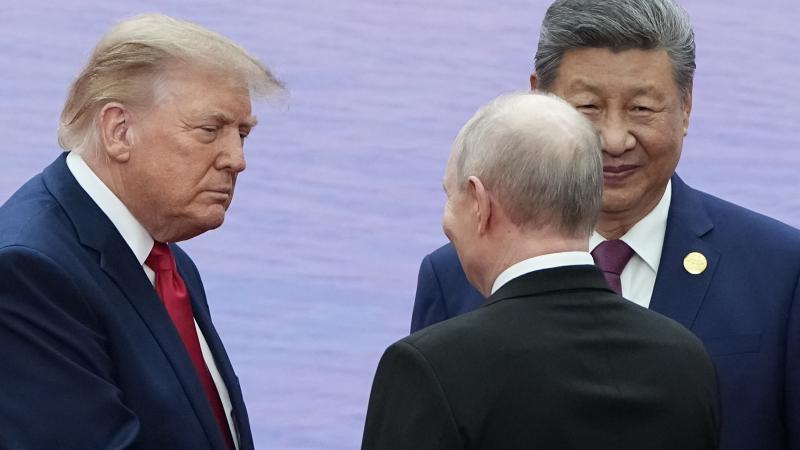
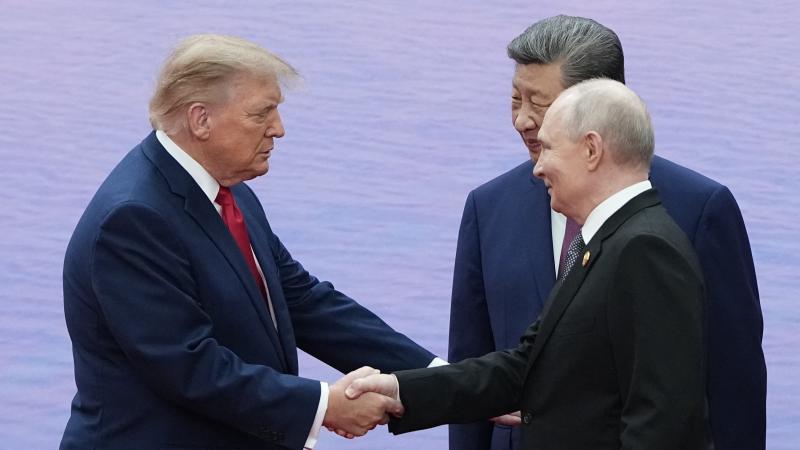
Still, the administration's direction going into Thursday is clear: tighter controls, a shorter guest list and a Treasury secretary saying publicly where Trump drew the line. The trilateral with Xi and Russian President Vladimir Putin is set for 2:30 p.m. Thursday local time. Whether chips come up or not, Beijing will notice who isn't in the room.
Amanda Head is White House Correspondent for Just the News. You can follow her here.
The Facts Inside Our Reporter's Notebook
Links
- only executive aboard
- told CNBC
- same interview
- flew with Trump
- says it takes
- "Stand With Jensen"
- interim final rule
- written by
- reportedly rushing
- condemned the measures
- no longer sell
- forecast that assumes
- said Monday
- Blackwell chips
- Nine countries signed
- probing Trump's approval
- dropped its inquiry
- possible Lutnick ouster
- trilateral with Xi
- here

Top Stories


Trending
Just the News Spotlight
Just News, No Noise