Related Articles
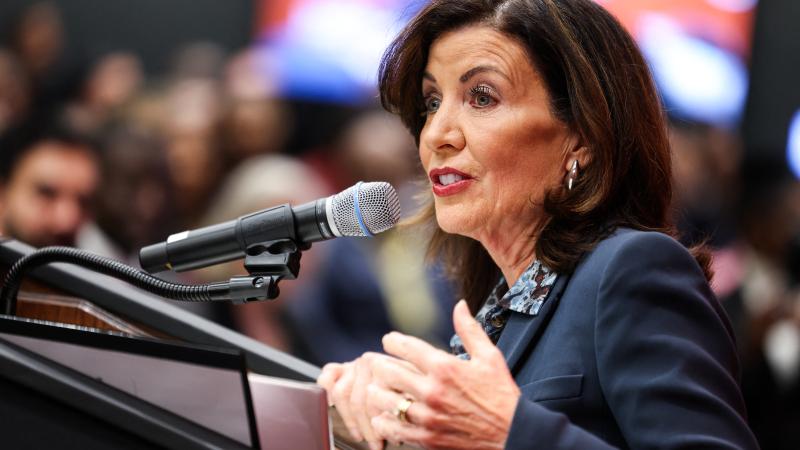



While disagreeing on most else, teacher unions and conservative education policy reformers share views on cellphone bans, AI guardrails in K-12 public schools.
Teachers unions and education reformers are historically longtime rivals – frequently bumping heads over policies surrounding school choice, parents' rights, and Diversity, Equity, and Inclusion practices in K-12 schools.
There's one issue, however, upon which these groups agree – that technology, creeping first via phones and now Artificial Intelligence, is interfering with student learning.
"Social media and student personal device use have become a constant presence in our schools,” said Becky Pringle, president of the National Education Association, the nation’s largest teachers union. “And educators are seeing firsthand the serious impact they can have on student mental health, safety and learning.”
A survey of NEA educators found 90% of them consider the connection between students' mental health and the overuse of personal devices during the school day a “critical concern,” and the NEA offers templates for AI and student personal device policies on their website for districts to address these issues.
School choice advocate Virginia “Ginny” Gentles also has serious concerns about technology overload in the classroom, and she thinks parents, school districts and legislators should share the burden of limiting screen use of children in education settings.
“Smartphones have become constant companions for America’s students and a pernicious source of distraction, anxiety, and academic decline,” she asserted, noting school districts’ proven ability to set guidelines for dress code, attendance, and behavior.
“Banning smartphones from bell-to-bell is no different.”
School districts across the country have enacted laws restricting and outright banning personal technology devices in classrooms.
Cellphone bans – which restrict students' use of personal devices such as phones, iPads, and smartwatches during most of the school day ("instructional time") or all of it ("bell-to-bell") – have grown exponentially in recent years amid rising concerns about their impact on student wellbeing and learning.
Florida’s statewide cellphone ban, instituted in 2023, restricted cellphone use during instructional time. In the years following, the state reported a decrease in suspensions and unexcused absences, and higher test scores.
Aaron Leske, an eighth-grader from Minnesota whose school has a bell-to-bell no-cellphone policy for all middle-schoolers, says he thinks the rules “helps the whole class stay focused [during] work time.”
“Before this rule, phones were a big distraction in class,” he said, adding that students would often use their phones or text each other during instructional time.
“I think the benefits do outweigh the drawbacks because they can get an education without getting distracted by their phones,” he continued.
Thirty-five states and Washington D.C. currently maintain such device-restricting laws – 25 of which are “bell-to-bell.”
Ethical AI practices have also received near-unanimous support amidst concerns over student data privacy, although legislation frequently lags behind the quickly-evolving industry.
Randi Weingarten, president of the American Federation for Teachers, the nation’s second-largest teachers union, gave a speech in May titled, “Devices Down, Eyes Up, Hands-On: 10 Points to Boost Teaching and Learning in the AI Era,” which rolled out an action plan for school administrators to address growing technology use.
The plan recommends no student-facing AI in K-12 public schools, the establishment of a ‘gold standard’ for AI safety and privacy, independent research on the “effects of AI, screens and technology on students,” and bans on screens for children in Pre-K through 2nd grade.
The document also condemned “social companion” chatbot use at least until the age of 16.
The Heritage Foundation, a voice in conservative education reform, believes the growth of AI is unavoidable – creating an urgent need for guardrails.
“We cannot and should not try to stop AI development. That would be neither realistic nor desirable, especially in an environment where our adversaries will not slow down," the organization said.
Rather, legislators' real quandary is "whether to govern powerful systems early, while leverage still exists, or to react after control has already slipped."
Heritage says that “policymakers and families should scrutinize proposals to adopt artificial intelligence in education,” warning that “when powerful technologies are introduced without clear limits, safeguards often arrive too late.”
“Protecting children, supporting families, and preserving educational integrity must remain the central goals.”
Angela Morabito, spokesperson for Defense of Freedom Institute, a conservative education policy think tank, echoed this, emphasizing the need to retain human-focused education.
“State leaders, local leaders, and parents will need to actively determine what is best for students as [AI] develops,” Morabito told Just the News exclusively.
“No matter how advanced AI becomes, it cannot do the actual work of learning, which is the core of education.”
Despite such unity on cellphone and AI policies, the sides do not align on every aspect of the issue.
After a March event hosted by first lady Melania Trump meant to "empower children with technology and education," featuring "humanoid educators,” the NEA accused the White House of “sidelining educators, parents and communities,” while AFT’s President Weingarten called the initiative “every parent’s nightmare.”
The nation's largest teachers unions also urge increased education funding and frequently decry President Trump’s alliances with big corporations and billionaires.
As part of their ‘Devices Down, Eyes Up, Hands-On’ plan, the AFT recommends a “tech tax,” to force large tech companies to “pay their fair share”—an economic policy most conservative reformers oppose.
Still, broad support for technology restrictions in education remains a cause which transcends political divides, and cellphone policies have been adopted and proven successful in schools across America.
Eighty percent of New York teachers reported positive student outcomes, such as increased engagement and improved social connections, following a statewide ban during the 2025-2026 school year.
“I successfully fought for New York schools to go phone-free because our kids succeed when they’re learning and growing, not clicking and scrolling,” said New York Democratic Governor Kathy Hochul, “and these survey results show our nation-leading policy is working.”
The benefits go beyond basic protections; at Dallas ISD, students checked out 24% more library books following Texas’ state-wide cellphone ban.