Majority of voters want NASA to utilize reusable rockets in Space Race 2.0 with China: poll
Steve Yates, senior research fellow for China and National Security at the Heritage Foundation, warns that China is not in the race to the moon as a scientific expedition. The adversarial nation sees it as strategic terrain to control.
A new poll finds that a majority of voters want NASA to utilize the kinds of reusable rockets that companies such as SpaceX and BlueOrigin are developing, as opposed to the one-time rockets the space agency has used for generations.
The poll, which was sponsored by the Space Frontier Foundation and conducted by RMG Research, found that 65% of registered voters believe NASA should utilize modern, reusable rockets. Of those polled, 21% believe the agency should stick to traditional, single-use rockets, and another 14% weren’t sure.
Support for reusable rockets was highest among men, with 73% saying they want NASA to use them, whereas only 58% of women said the same. A majority of Republicans favored the modern rockets, with 66% saying NASA should use them, whereas only 57% of Democrats said the same.
This survey of 1,000 registered voters was conducted online by Scott Rasmussen on December 10-11, 2025, and it has a margin of error of not more than 3 percentage points.
Our great rival
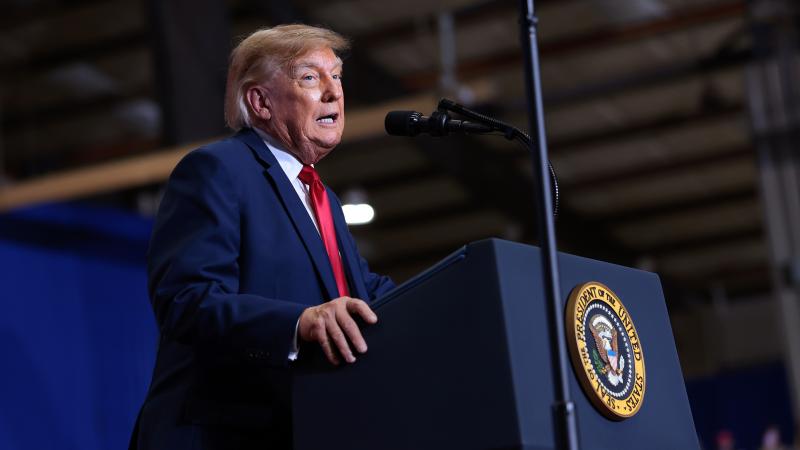
The results come as the Trump administration signals a growing interest in the U.S. returning to the moon. During his confirmation hearing earlier this month, NASA Administrator Jared Isaacman — President Donald Trump’s pick to run the agency — told the Senate Commerce, Science and Transportation Committee that the U.S. will return to the moon before “our great rival” beats us there.
Once there, Isaacman said in his testimony, America will establish an “enduring presence to understand and realize the scientific, economic and natural security value on the lunar surface.”
While Isaacman never stated who this “great rival” is, China is pursuing its own lunar program. The country conducted tests of a rocket this summer, Space.com reported, which is designed to take astronauts to the lunar surface.
Steve Yates, senior research fellow for China and National Security at the Heritage Foundation, told Just the News that Americans understand how important this “Second Space Race,” as he called it, is. China shouldn’t be expected to be any more of a responsible stakeholder on the moon than it has been on Earth, he said.
“China is not treating the moon as a scientific destination, rather they are treating it as strategic terrain. If Beijing occupies the lunar surface first, they won’t share access or play by international norms. They will move to lock up territory, resources and influence just as they have in the South China Sea,” Yates also said.
Opposing waste
Trump’s budget proposal released in May seeks to cut funding for parts of NASA’s Artemis program. The proposed cuts include the Space Launch System, a powerful rocket that’s designed to transport the Orion astronaut capsule, astronauts and cargo to the moon in a single launch, something of which no rocket is currently capable.
The rocket is built by Boeing and Northrop Grumman, and its first launch came after more than a decade of development and a cost of about $65 billion. Originally, the rocket alone was estimated to cost $10 billion through 2017, but it ran over budget through its development and delayed launch.
The Space Frontier Foundation poll asked voters whether the federal government should continue to partner with Boeing, or should buy rockets from private companies if they achieve better results at lower costs. The results were inside the margin of error, with 44% supporting buying rockets and 41% supporting the partnership with Boeing. Another 14% were unsure.
Sean Mahoney, executive director of the Space Frontier Foundation, told Just the News that the results show that Americans don’t oppose space exploration. They only oppose waste, he said.
“Polling shows that taxpayers understand a program like the Space Launch System (SLS), built around one-time, disposable rockets costing approximately $4.2 billion per launch, is not a sustainable way for NASA to expand operations on the lunar surface, let alone establish a long-term human presence beyond Earth,” Mahoney said.
Other polling has shown American support for space exploration. A CBS News poll in July found that about two-thirds of Americans support the U.S. going to the moon and exploring mars.
Streamlining operations
Trump signed an executive order in August directing the federal government to improve regulations that will make it easier for the United States to compete for the exploration and development of “space-based industries,” and to get ahead of its adversaries.
Among its directives is for the federal government to streamline permitting approvals for operations and remove regulatory barriers to commercial launch, commercial reentry and the construction of spaceports.
Chad Wolf, former acting secretary of the Department of Homeland Security, told Just the News that American leadership in space will depend on speed, resilience and competition. Bureaucracy and longstanding legacy systems will deter success, he said.
“The latest polling confirms what strategic leaders and Members of Congress have long known: Americans deserve a space program that delivers results faster, at lower costs and keeps us ahead of China in a new era of global competition,” also said Wolf, who is a member of the National Space Council.
With Beijing racing to dominate the frontiers of space, the U.S. will slow progress if it continues to rely on one-time, unsustainable launch systems that drain resources, he said.
“Smart reforms and a competitive commercial approach will ensure NASA remains mission-focused, fiscally responsible, and capable of winning Space Race 2.0,” Wolf said.
Field work for the Space Frontier Foundation survey was conducted by RMG Research, Inc. Certain quotas were applied, and the sample was lightly weighted by geography, gender, age, race, education, internet usage, and political party to reasonably reflect the nation’s population of registered voters. Other variables were reviewed to ensure that the final sample is representative of that population.
The Facts Inside Our Reporter's Notebook


Top Stories

Trending
Just the News Spotlight
Just News, No Noise