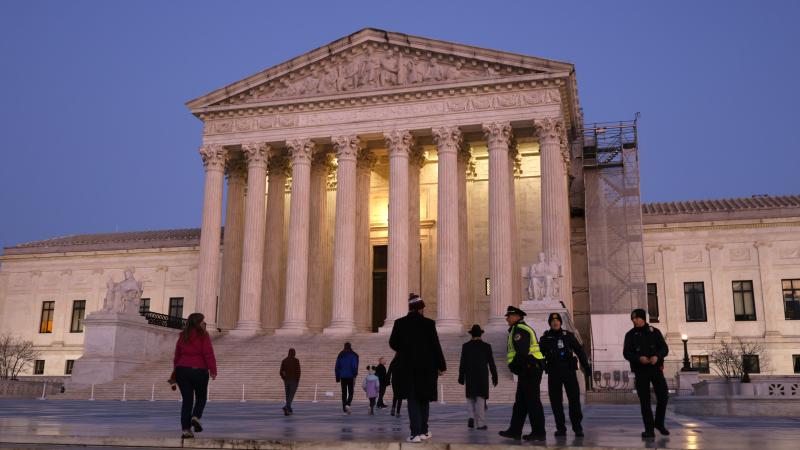
Supreme Court strikes down Louisiana congressional map as unconstitutional racial gerrymandering
The Supreme Court on Wednesday released an opinion striking down a set of Louisiana congressional district maps that added a second majority black district.
The Supreme Court on Wednesday released an opinion striking down a set of Louisiana congressional district maps that added a second majority black district.
In 2022, Louisiana redrew its congressional district maps, which a court later ruled likely violated the Voting Rights Act because they did not include a second majority black district. The state then created a new set of maps with an explicit racial consideration to create a second black majority district, which the Court on Wednesday found was unconstitutional.
"Because the Voting Rights Act did not require Louisiana to create an additional majority-minority district, no compelling interest justified the State’s use of race in creating SB8, and that map is an unconstitutional racial gerrymander," wrote Justice Samuel Alito.
File
"The State’s attempt to satisfy the Middle District’s ruling, although understandable, was an unconstitutional racial gerrymander, and we therefore affirm the decision below," Alito wrote.
The 6-3 decision is likely to trigger a series of map redraws, especially across the South, in which a number of majority black congressional districts may soon be drawn out.
The addition of that second district amounts to an unconstitutional racial gerrymander under the 14th and 15th Amendments.
Such a sweep could net Republicans several districts in the battle for the House in 2026.
The ruling stems from years of litigation over Louisiana’s redistricting following the 2020 census. The state’s earlier map, which included only one majority-Black district, faced legal challenges alleging it diluted Black voting power in a state where black residents comprise roughly one-third of the population.
After a federal court found a likely violation of the Voting Rights Act, the Republican-controlled legislature adopted a revised map in 2024 that added a second majority-black district, Congressional District 6.
That map was subsequently challenged by a group of White voters led by plaintiff Phillip Callais, who argued that the new district was drawn predominantly on the basis of race, in violation of the Constitution.
Justice Clarence Thomas filed a concurring opinion to Alito's, joined by Justice Neil Gorsuch.
In dissent, Justice Elena Kagan, joined by Justices Sonia Sotomayor and Ketanji Brown Jackson, argued the decision undermines states' ability to remedy Voting Rights Act violations through race-conscious redistricting.
The ruling is expected to have significant implications for redistricting nationwide, potentially limiting the use of majority-minority districts as remedies for vote dilution claims.
Ben Whedon is the Chief Political Correspondent at Just the News. Follow him on X.
The Facts Inside Our Reporter's Notebook



Top Stories



Trending
Just the News Spotlight
Just News, No Noise