Deal with the Devil: How Canada's new partnership with China could backfire
Canadian Prime Minister Mark Carney’s new partnership with Beijing betrays his calls to preserve the “international order” and could backfire economically by angering Canada’s biggest trading partner, the United States.
Canadian Prime Minister Mark Carney’s new plan to cozy up to Beijing betrays his calls to preserve the “international order” he says is under threat from Donald Trump, and Canada’s economic dependence on the United States may cause his plan to backfire.
In a speech to the global elite at Switzerland’s Davos resort town this week, Carney warned attendees that the “rules-based order” established by the United States and its allies in the wake of the Second World War is fraying amid the reemergence of great power conflict–principally the rivalry between China and America.
“Every day we’re reminded that we live in an era of great-power rivalry,” Carney said. “That the rules-based order is fading. That the strong can do what they can, and the weak must suffer what they must.”
Canada's "new strategic partnership"
But, he called on Canada and its European allies to band together to preserve that order, in the face of challenges from the U.S. He warned, “The middle powers must act together because if we’re not at the table, we’re on the menu.”
Carney’s remarks came on the heels of his trip to China last week when the prime minister negotiated a new “strategic partnership” with the Communist regime in Beijing, promising to expand trade and mutual investment.
The Liberal Canadian politician made no secret of his purpose. The new deal, which represented Canada "recalibrating" its relationship with China, would set up the country for the “new world order,” one in which the United States’ ally would try to distance itself from its southern neighbor.
When Carney left Beijing, the new “strategic partnership" committed China and Canada to increase trade and investments as well as closer collaboration on the very “global governance” that Carney says President Trump has abandoned. The two countries also promised close cooperation on law enforcement — focusing on drug trafficking and cybercrime — and to increase cultural exchanges.
Sadler: Carney's approach "antithetical" to Canadian values
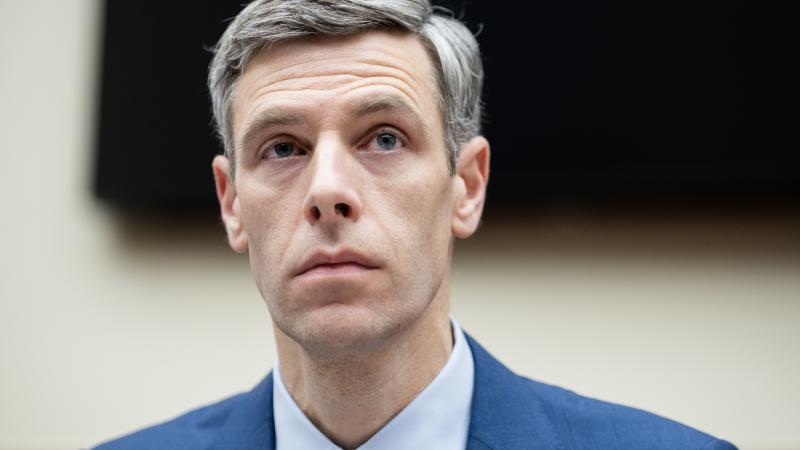
Both issues could come back to bite Carney at home, Senior Research Fellow at the Heritage Foundation, Brent Sadler, told Just the News. “Prime Minister Carney's trip to Beijing makes no sense,” Sadler told the "Just the News, No Noise" TV show on Thursday.
“It might feel good at the moment to try to stick his finger in what he thinks is President Trump's eye,” said Sadler. “The reality is he went to a country of an authoritarian communist regime that doesn't acknowledge or respect religious freedoms, personal rights to freedom of speech. They have a social credit system that you get judged on every day in access to services, let alone medical services and everything else.”
He added, “It's everything that's antithetical to what the Canadian people seem to think and embrace in a liberal society. Makes no sense.”
China's human rights record ignored by Carney
Indeed, the United Nations — a key governance body of the rules-based order that Carney supports — found in 2022 that China was responsible for committing “serious human rights violations” against the Uyghur minority group in the eastern region of Xinjiang.
The report from the UN Office of the High Commissioner for Human Rights concluded that the Muslim Uyghur citizens of China face imprisonment, harassment, torture, and cultural erasure. The repression is justified by Beijing as an anti-terrorism policy.
The report notes that the Chinese government referred Uyghur citizens to so-called “Vocational Education and Training Centres” without legal basis where they are subjected to forced labor. Many former detainees have testified to torture in these facilities, including forced medical procedures and beatings, the report noted.
In addition to the United Nations’ concerns, the United States State Department determined in Jan. 2021 the Chinese government had committed both crimes against humanity and genocide against the Uyghur population. The State Department likened the treatment of Uyghurs in Xinjiang to the genocide perpetrated by Adolf Hitler’s Nazi regime in Germany.
China has also failed to respect the international law of the seas. In 2016, an international court ruled in favor of the Philippines, which had accused China three years earlier of encroaching on maritime rights in the South China Sea, where Beijing had laid claim to several outcroppings and had begun to militarize them.
Despite the court ruling that China had violated the United Nations Convention on the Law of the Sea, of which it is a signatory, its leadership said it would not recognize the judgment.
Beyond the accusations of political double-talk, Carney will also face an indisputable fact of economics: the United States is Canada’s largest trading partner by far.
According to the latest data from the Canadian government, more than 75% of all Canadian exports are destined for the United States compared to 10.5% for the Indo-Pacific, the region in which China is located. Nearly half of Canada’s imported goods come from the United States compared with 24.1% from the Indo-Pacific, the data show.
The data indicate Canada's overwhelming economic dependence on the United States, such that U.S. Commerce Secretary Howard Lutnick says will make it extremely difficult for Canada to actually cozy up to China. “This is the silliest thing I’ve ever seen,” Lutnick said of the proposition that China will increase imports from Canada.
Even E.U. nations are considering hitting China with higher tariffs
China is currently facing an overcapacity crisis–its industrial and manufacturing sectors are currently producing far more goods than its domestic economy and trading partners can absorb. The situation has even spurred European countries to consider higher tariffs on China to prevent dumping in their markets and to keep their own industries competitive, Just the News previously reported.
It remains to be seen how China could import even more goods from Canada given this imbalance.
Lutnick also said Carney’s détente with Beijing will also put Canada in a worse negotiating position as the U.S. and Canada rehash the USMCA trade agreement. “They are playing with a set of rules that they haven’t really thought through,” Lutnick said.
Heritage’s Sadler thinks this fundamental vulnerability, both in economic terms and the accusations of politics to which Carney will be exposed at home, will ultimately push Canada back into the arms of the United States.
“I think very quickly, a lot of the ideologically aligned people will start to see this hypocrisy, and I think the whole effort will fall apart fairly quickly. And I would put my money on that,” Sadler told Just the News. “I think the Canadian government under Prime Minister Carney is going to reverse course, because he is pragmatic, and will try to cut a deal with President Trump in the future.”
The Facts Inside Our Reporter's Notebook
Links
- Carney said
- strategic partnership
- found in 2022
- from the UN Office of the High Commissioner for Human Rights
- determined in Jan. 2021
- ruled in favor of the Philippines
- would not recognize
- latest data from the Canadian government
- Lutnick said
- an overcapacity crisis
- spurred European countries to consider higher tariffs

Top Stories


Trending
Just the News Spotlight
Just News, No Noise