Reading the law, Trump could implement wide immigration reforms with his enumerated powers
President's message follows an Afghan national charged with murder in ambush of two National Guard members, killing one.
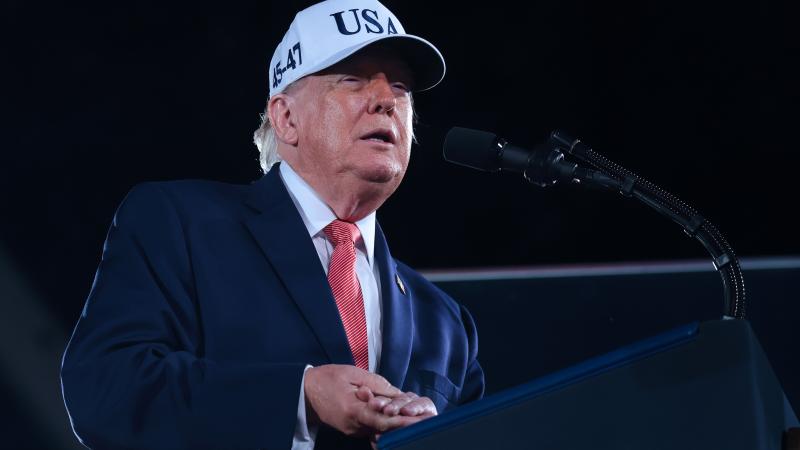
In a late-night Truth Social post published on Thanksgiving evening, President Trump called for “reverse migration” and promised sweeping changes to U.S. immigration policy.
His message came in the wake of a tragic shooting in Washington, D.C., where a 29-year-old Afghan national allegedly gunned down two members of the National Guard. One soldier has died, and the other remains in critical condition.
In a later reported incident, Fox News published that an "Afghan national was arrested this week after posting a video of himself on TikTok indicating he was building a bomb with an intended target of the Fort Worth area in Texas," citing the Department of Homeland Security (DHS).
In his post, Trump vowed to “permanently pause migration from all Third World Countries,” revoke what he called “millions of Biden illegal admissions,” end federal benefits to non-citizens, and denaturalize and deport individuals that the administration deems incompatible with “Western Civilization.”
“Only REVERSE MIGRATION can fully cure this situation,” he declared, before adding a pointed Thanksgiving sign-off: “HAPPY THANKSGIVING TO ALL, except those that hate, steal, murder, and destroy everything that America stands for—You won’t be here for long!”
Trump’s allies quickly amplified the post, hailing it as a defining statement of his presidency. But how exactly will the president turn these promises into policy? Federal law provides several possible paths forward.
Suspension of "new entrants" a long-standing statutory authority and practice
At the forefront of Trump’s legal toolkit is expansive authority to suspend the entry of new immigrants. Under federal law, the president can suspend the entry of aliens or impose restrictions on their entry if he determines that doing so is in the national interest.
The relevant statute states that: "Whenever the President finds that the entry of any aliens or of any class of aliens into the United States would be detrimental to the interests of the United States, he may by proclamation, and for such period as he shall deem necessary, suspend the entry of all aliens or any class of aliens as immigrants or nonimmigrants, or impose on the entry of aliens any restrictions he may deem to be appropriate."
Every president since Ronald Reagan has invoked this statutory authority to pause immigration in some form. This power has been cited as the basis for blocking the issuance of certain visa categories, suspending entry from specific countries, imposing COVID-19 travel restrictions, and imposing sanctions-related travel bans.
The Supreme Court has repeatedly reaffirmed this statute’s breadth. In its 1993 Sale v. Haitian Centers Council decision, the Court upheld a program established by President George H. W. Bush through Executive Order No. 12807, which was based on advice involving legal authority.
According to the Court, “[i]t is perfectly clear that 8 U.S.C. § 1182(f) grants the President ample power to establish a naval blockade that would simply deny illegal Haitian migrants the ability to disembark on our shores.”
Similarly, in the 2018 decision in Trump v. Hawaii, the Court ruled that Section 1182(f) granted President Trump broad authority to restrict entry from eight foreign states. The Court noted that Section 1182(f) is a “comprehensive delegation” that “exudes deference to the President,” and it gives him broad discretion over every detail of the entry restrictions he sets under it, including “when to suspend entry,” “whose entry to suspend,” “for how long,” and “on what conditions.”
The President also has power under 8 U.S.C. § 1185(a)(1) to adopt “reasonable rules, regulations, and orders” governing entry or removal of aliens, “subject to such limitations and exceptions as [he] may prescribe.” The Supreme Court has explained that the authority conferred in this provision “substantially overlap[s]” with Section 1182(f).
While the President’s authority to suspend the entry of new aliens is broad, it is not limitless. Courts have held that Section 1182(f) does not allow the president to expressly override other parts of the Immigration and Nationality Act or other federal laws. This caveat could potentially form the basis of legal challenges to Trump’s efforts.
Revocation of Visa Petitions and Green Cards
Under 8 U.S.C. §1155, the Secretary of Homeland Security (or anyone to whom the Secretary delegates this authority) may revoke approval of any immigrant’s visa petition at any time for “good and sufficient cause.”
The Supreme Court examined this statutory provision just last term when it held that the Secretary’s decisions under Section 1155 are not reviewable in federal court. In its decision, the Court explained that Congress had never specified the standard of review for such instances, and adopted by default what legal analysts call "abuse of discretion," the highest standard for a challenging party to overcome.
Under duly debated, passed and signed federal law, the federal government may also revoke a green card if the individual was inadmissible at the time he entered the United States or at the time he became a lawful permanent resident. In 8 U.S.C. §1182, Congress outlined several grounds on which an alien is ineligible for a visa or admission. These grounds include certain health-related issues, criminal convictions, security concerns, involvement in terrorism, fraud, and misrepresentation. If a green card holder is found to be inadmissible, their permanent resident status can be terminated through removal proceedings.
A green card can also be revoked if an alien meets any “grounds for deportability” under federal law. Some of those grounds include certain criminal convictions, failure to comply with registration requirements, terrorism activities, and illegal voting.
A thorough review of green cards appears to be underway. The day of President Trump’s post, USCIS Director Joseph Edlow posted on X that he has “directed a full scale, rigorous reexamination of every Green Card for every alien from every country of concern.” He later announced that asylum decisions will be suspended “until we can ensure that every alien is vetted and screened to the maximum degree possible.”
Denaturalization may become more common under the law
The executive branch is also empowered to pursue denaturalization in certain circumstances. Denaturalization is the legal process through which the government revokes the citizenship of a naturalized citizen. This process cannot be pursued against anyone born in the United States.
Under 8 U.S.C. § 1451, federal prosecutors may initiate proceedings to revoke naturalization through civil proceedings. Prosecutors may also seek criminal convictions for naturalization fraud under 18 U.S.C. § 1425.
For civil denaturalization, the government must provide "clear, convincing, and unequivocal evidence" that the individual procured naturalization illegally or concealed or willfully misrepresented a material fact during the process. The burden of proof on the government is high, but there is no statute of limitations for pursuing a civil denaturalization.
To prove a criminal conviction, the federal government must establish beyond a reasonable doubt that the individual knowingly obtained or attempted to obtain naturalization through fraud for him or for another person. The statute of limitations for a criminal violation is 10 years from the date of the offense.
An individual whose U.S. citizenship is revoked returns to the immigration status he had before becoming a U.S. citizen. The person could be deported if he lacks lawful immigration status after he is denaturalized or serves jail time.
Due Process Considerations
Any enforcement of immigration restrictions must, of course, comply with constitutional due process requirements.
Earlier this year, in a case involving the Trump administration’s efforts to deport non-citizens under the Alien Enemies Act, the Supreme Court emphasized that the Fifth Amendment of the Constitution entitles aliens to due process of law in the context of removal proceedings.
Due process requires, the Court explained, notice and an opportunity to “actually seek habeas relief.” In other words, the detainee must have enough time and information to contact a lawyer, file a habeas petition in federal court, and pursue whatever legal remedies are available.
Trump allies question veracity of people granted legal status
Some lawmakers are already moving to implement Trump’s agenda on this issue. On November 20, Congressman Chip Roy, R.-Tex., introduced the PAUSE Act (officially “Pausing All Admissions Until Security Ensured Act,” H.R. 6225). The legislation would impose an immediate moratorium on almost all immigration to the United States until Congress enacts a series of systemic reforms. The bill would end the visa lottery and family-based “chain migration,” eliminate programs like Optional Practical Training (OPT) for foreign students, expand fees on employment-based visas such as H-1B, and limit entry of individuals that are deemed to be security risks.
"The problem isn’t just illegal immigration; it’s also legal immigration,” Congressman Roy said in a statement. “While the Biden administration opened our borders and allowed millions to flood into our country, they also rubber-stamped millions more arriving through convoluted legal schemes, completely overwhelming the system.”
The Facts Inside Our Reporter's Notebook


Top Stories



Trending
Just the News Spotlight
Just News, No Noise