After years of anti-fossil fuel policies, Colorado’s Boulder unlikely to achieve its climate goals
Boulder, Colorado is suing oil companies for climate change and setting aggressive emission-reductions target. A Just the News analysis shows the city is unlikely to reach either of those goals, but the city says it's not backing down.
When it comes to anti-fossil fuel policies, few cities have pursued them with as much gusto as Boulder, Colorado. In 2006, Boulder became one of the first local governments in the nation to adopt emission reduction targets. Then in 2019, the city went into a full-blown panic over emissions, declared a “climate emergency,” and exponentially increased its targets.
While progressive cities feel good setting targets to eliminate the use of fossil fuels, achieving those targets is another thing entirely. Just the News analyzed Boulder’s progress toward its goal of being at net-zero emissions by 2035. Based on its current rate of emissions reductions, the city would need to nearly double the pace that it is reducing emissions to meet that goal.
The town is going to find it much harder to achieve reductions going forward. Much of its progress so far has been from reducing emissions associated with electricity generation. The U.S. as a whole has seen a drop in emissions, largely due to a transition from coal to natural gas.
Yet, the grid still needs those coal plants. A new report by Xcel Energy, the utility that supplies Boulder’s electricity, warns that if it shuts down its coal plants as scheduled, there will likely be blackouts in Colorado.
More than that, even if Boulder — a city of only 25 square miles with a population of approximately 106,000 people — were to reach net-zero by 2035, it would have no meaningful impact on global warming due to rising emissions everywhere else.
'Ridiculous' proposal, ambitious targets
The city of Boulder has long shown hostility to fossil fuels. It was one of the first local governments to file a lawsuit against oil companies claiming to be owed damages stemming from climate change. That lawsuit is now before the Supreme Court, which will consider if such cases belong in state courts at all.
In 2024, Rep. Harriet Hageman, R-Wyo., challenged Boulder to demonstrate the potential to eliminate fossil fuels by becoming a fossil fuel-free demonstration city. Despite fervent plans to eliminate all use of fossil fuels in a very short timeframe, Boulder City Councilman Mark Wallach told Wyofile, a left-leaning nonprofit publication based in Wyoming, that Hageman’s proposal is “ridiculous.”
With its policies based on the belief that fossil fuels are creating a terrifying emergency, it’s not clear why Wallach considered such a proposal to be unreasonable, other than such a demonstration would create hardships that come with giving up the benefits of fossil fuel use. At the time, Just the News reached out to Wallach, who was reelected the following November, and he didn’t respond.
Whatever the case, the city remains committed to its climate goals. Boulder’s plan today is to have 100% emissions-free electricity by 2030, reach net-zero emissions by 2035, and then it plans to be carbon-negative — meaning it sinks more greenhouse gas emissions than it puts out — by 2040.
For comparison, San Francisco, California, plans to reach net-zero by 2040. Boston, Massachusetts, plans to reach net-zero by 2050, as do Phoenix, Arizona, and Miami, Florida. Boulder’s goals may be the most ambitious of any city.
Difficult but necessary
Despite the likely prospect of failure, Boulder stands by its pledges and says the targets aren’t unrealistic.
Layra Nicli, senior program manager in Boulder’s Communications and Engagement Department, told Just the News that the targets were never selected because they’d be easy. Rather, they were developed based on what the Intergovernmental Panel on Climate Change says is necessary to avoid the “most severe climate impacts,” she said.
“Characterizing the targets as ‘unrealistic’ assumes they were designed to reflect what is easiest or most immediately achievable. In fact, they are intended to reflect what climate science indicates is necessary,” Nicli said.
The city of Boulder keeps a tally of the various sources of emission sources that it will need to eliminate to reach its 2035 target. This includes propane and natural gas people use to heat their homes. It also includes local air travel, and vehicles to cross Boulder’s city limits.
According to Boulder’s Community Greenhouse Gas Inventory, the city’s emissions have dropped 29% between 2018-2024. By 2030, it will need to create a drop 250% higher to reach its overall emissions reduction target of 70%, which includes 100% emissions-free electricity. Then, it will need to reduce another 30% emissions in five years to reach its net-zero goal.
Its pace of annual reductions between 2018-2024 was 4.8%. At that pace, it will only reduce a total of about 54% by 2030 from the 2018 baseline. From 2020-2021, Boulder saw an increase, which is likely due to the pandemic. From 2021-2022, it reduced emissions by 6.9%. Then, from 2022-2023, they fell 3.9%. Then from 2023-2024, the latest year available, they fell 7.9%.
From 2018-2024, emissions in Boulder fell from 1,584,573 metric tons to 1,117,543, a drop of 467,030 metric tons.
Coal retirements threaten blackouts
While most sources of emissions saw reductions, almost all of that total was emission reductions from electricity generation. In that time, emissions from electricity in Boulder fell from 800,482 metric tons to 420,995 metric tons, a drop of 379,487 from a total drop of 467,030.
Emissions from electricity still account for 44% of Boulder’s total emissions. All of that will need to be eliminated in just four years to achieve its 100% emissions-free electricity by 2030 goal. However, even making emissions reductions may be hard going forward. Last month, Xcel Energy released a report, known as the “Comanche Report,” which stated that the utility company will face a “capacity deficit” if it doesn’t keep its Colorado coal plants open.
Energy analysts with Always On Energy explain on their “Energy Badboys” Substack that a “capacity deficit” means the utility can’t meet its reliability requirements and blackouts are likely. Sarah Montalbano, who is on the Always On Energy team, explains on her Substack that Xcel was the first utility to pledge 100% carbon-free energy, and it set a target date of 2050.
Now, the utility is begging Colorado regulators to let it keep running its coal plants until 2030. Montalbano wrote that utilities earn no regulated rate of return on fuel expenses. Instead, they earn a guaranteed 9% to 11% return on capital investments. So for the past several years, Xcel pursued a renewable energy buildout, along with supporting infrastructure, and its guaranteed returns have been to the pleasure of the utility’s shareholders. Though, ratepayers have had to pay for all that infrastructure with rapidly rising electricity rates.
Today, Montalbano wrote, 54% of Colorado’s electricity comes from reliable baseload thermal plants running on coal and natural gas. During January’s Winter Storm Fern, those plants supplied 85% of Xcel’s electricity generation, making them indispensable.
That means 421,000 metric tons of greenhouse gas emissions from Boulder’s electricity will drop very little between now and 2035, much less to zero by 2030.
Boulder going green would have no impact on global warming
Even if Boulder were to reach net-zero emissions by 2035, it would have almost no impact on global warming. Chris Martz, a meteorologist and policy analyst for the nonprofit Committee For A Constructive Tomorrow, built a tool to calculate the averted warming out to 2100 from emission reductions.
If Boulder eliminated 100% of its 1.1 million metric tons of greenhouse gas emissions in 9 years — a 9.1% annual reduction — the city would have averted 0.0004 degrees Celsius of warming out to 2100, according to Martz’s calculations.
Image
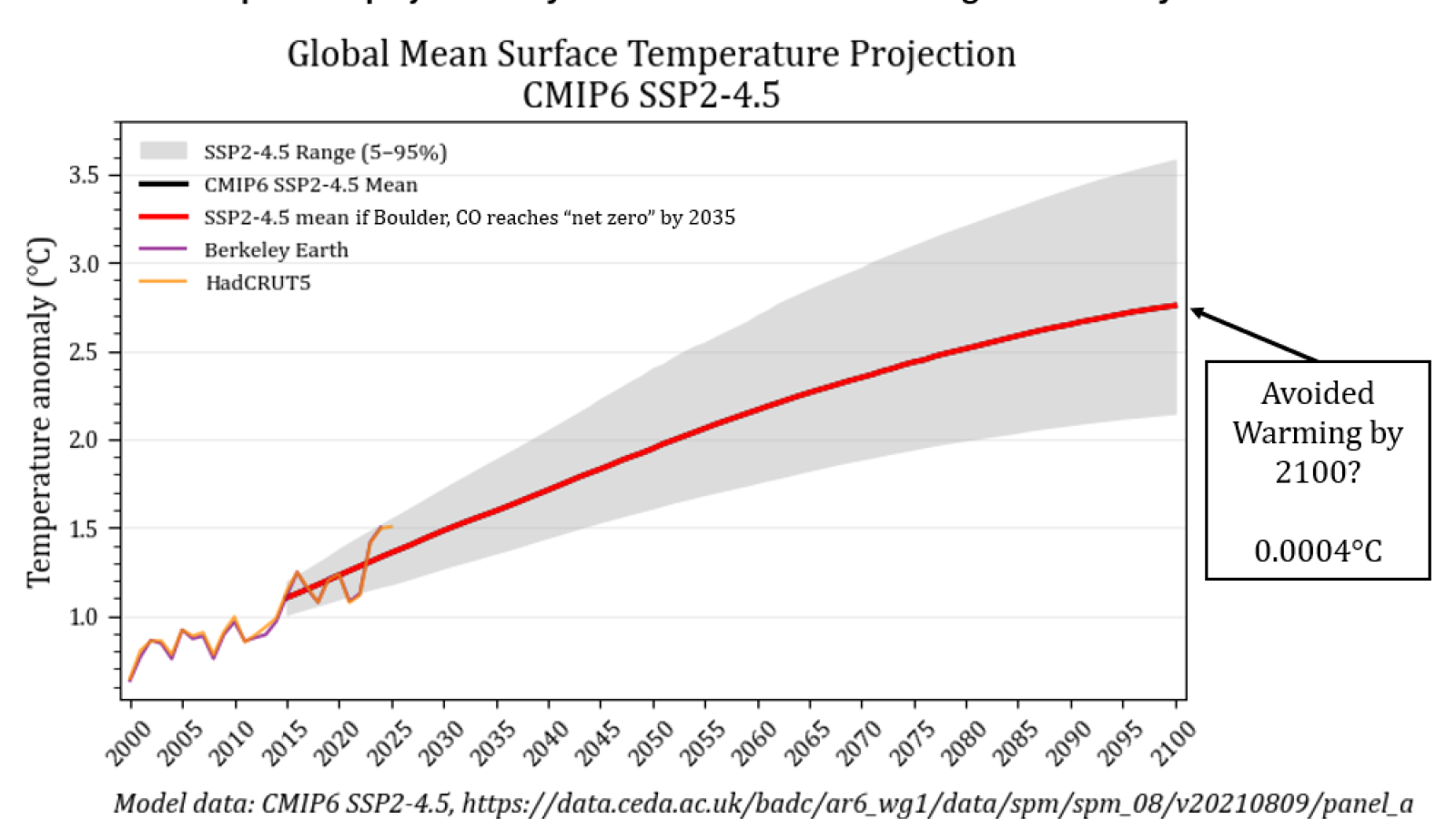
If Boulder, Colorado, reaches its goal of net-zero emissions by 2035, it will reduce global warming by 0.0004 Celsius by 2100.
(Courtesy Chris Martz)
Nicli with the city of Boulder said these facts don’t deter Boulder’s commitment to emissions reductions.
“Climate change is a cumulative global challenge, and no single city can measurably change global temperature outcomes on its own. That has long been understood. However, this does not make local action irrelevant. It is how large-scale change occurs,” Nicli said.
Despite Western governments' obsession with emissions reductions and an energy transition that isn’t materializing, that large-scale change isn’t happening. Emissions are rapidly rising globally, and any reductions Boulder has achieved are offset by emission increases in other countries, primarily China and India.
Costs rising, reliability failing
As the “Comanche Report” explains, either Colorado keeps its coal plants operating at least until 2030, or Coloradans will be sitting in the dark without heat during extreme cold events.
Nicli disputed that there is a choice between achieving net-zero emissions by 2035 and having economic growth. She said that utilities are required by the state to maintain reliability “throughout the energy transition.” Xcel’s warnings about coal plants, Nicli argued, are the result of near-term challenges associated with replacing aging power plants, coupled with population growth and supply chain constraints.
“In fact, reliability challenges have largely been tied to outages at existing coal facilities, underscoring the importance of bringing replacement resources online efficiently. Building modern energy resources strengthens reliability while supporting economic growth,” Nicli said.
The claim contradicts not only Xcel’s assessments of the need for those coal plants, but also those of the nonprofit electric grid watchdog, the North American Electric Reliability Corporation. Its long-term assessments have consistently found over the past few years that retirements of baseload energy sources and a growing reliance on unreliable wind and solar are driving reliability problems across the U.S.
A report by the Always On Energy analysts also found that states with renewable energy mandates saw rate-increase requests 32% higher since 2020 than states without such mandates. Likewise, states with these mandates have electricity prices at almost double the rate as states without mandates.
Doubling down on virtuous energy suicide
Despite the evidence that wind and solar degrade grid reliability and drive up electricity costs, Boulder insists it can power its whole city on wind, solar and batteries in just four years without harmful economic costs.
“From the city’s perspective, climate action and economic vitality are not competing priorities. Boulder’s approach is to reduce long-term energy costs, improve resilience, and create economic opportunity through energy efficiency, building upgrades, distributed energy resources, and expanded transportation options,” Nicli said.
Many states are running up against the reality that their climate policies and economic policies are at odds. New York’s Department of Environmental Conservation came to the conclusion that the state’s aggressive emission reduction targets, which are similar to Boulder’s, would place “extraordinary and damaging costs upon New Yorkers.”
New York Gov. Kathy Hochul is now trying to pull back from the Empire State’s climate ambitions. Massachusetts Gov. Maura Healey is delaying clean-heat standards in her state due to the cost burden. California, which is as anti-fossil fuel as Boulder, is working with closing refineries to import gasoline from overseas that Gov. Gavin Newsom insisted it wouldn’t need any more.
Nicli said that Boulder is not only going to stay the course, it’s going to pursue its goals more aggressively to ensure it meets its emission-reduction targets.
“Meeting 2030 and 2035 goals will require accelerated implementation, and the city’s focus is on expanding partnerships at the state, utility, and federal levels to make deeper reductions achievable; not reducing ambition, but increasing the pace and effectiveness of solutions,” Nicli said.
Kevin Killough is the energy reporter for Just The News. You can follow him on X for more coverage.
The Facts Inside Our Reporter's Notebook
Links
- adopt emission reduction targets
- climate emergency
- seen a drop in emissions
- coal to natural gas
- lawsuit is now before the Supreme Court
- challenged Boulder
- Councilman Mark Wallach told Wyofile
- hardships
- Boulder's plan
- For comparison
- Community Greenhouse Gas Inventory
- Comanche Report
- Energy Badboys
- explains on her Substack
- Committee For A Constructive Tomorrow
- that isn't materializing
- Emissions are rapidly rising globally
- primarily China and India
- long-term assessments
- report by the Always On Energy analysts
- came to the conclusion
- Hochul is now trying to pull back
- delaying clean-heat standards
- working with closing refineries
- follow him on X
Other Media
Image
If Boulder, Colorado, reaches its goal of net-zero emissions by 2035, it will reduce global warming by 0.0004 Celsius by 2100.
(Courtesy Chris Martz)


Top Stories



Trending
Just the News Spotlight
Just News, No Noise