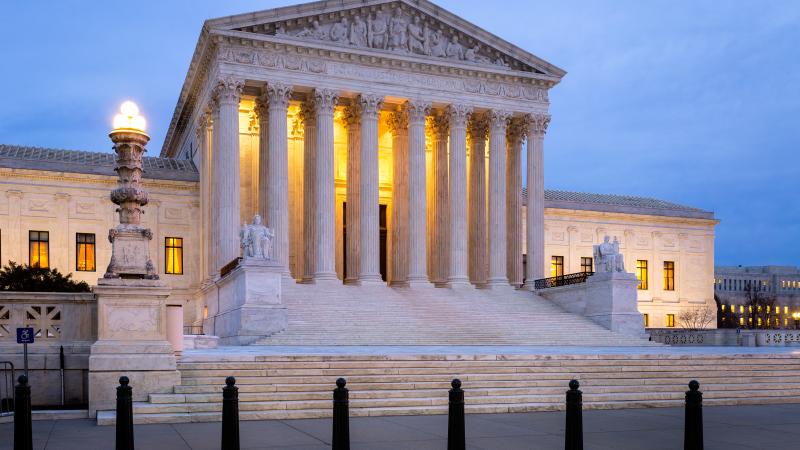
Court files expose role of private equity, marketers in Camp Lejeune lawsuit as victims wait for aid
Hundreds of thousands of Marines and their families are still waiting on compensation to be paid from federal funds, and this case shows how attorney fees from those taxpayer-funded settlements could end up paying a law firm’s lenders and marketers first.
For decades, Marines, their families, and civilian workers at Camp Lejeune drank and bathed in contaminated water. Congress opened the door to compensation in 2022, but since then, a private market — in fact, an industry — has grown up around their claims, and one Texas firm's bankruptcy shows how it works.
Dozens of law firms represent the more than 400,000 veterans and their families who have filed claims with the Navy, reported American Homestead Project, an NPR-affiliated public media project.
Two years before it filed for bankruptcy, one of the law firms, the Galindo Law Firm, based in Houston, Texas, signed a contract with a marketing company to bring in Camp Lejeune cases. The deal ended in arbitration and a $10.3 million court judgment against the firm. Now, bankruptcy records reviewed by Just the News show the marketing company’s owner is the one sponsoring the firm's plan to reorganize.
Those bankruptcy records do not claim or establish wrongdoing by the attorneys involved, and the firm does not have a court-appointed role in overseeing the cases.
Galindo, which is handling thousands of cases related to the contaminated water at Camp Lejeune in North Carolina, borrowed tens of millions of dollars from a private litigation lender, according to bankruptcy filings, and paid a third-party marketer to sign up clients.
$2 billion from taxpayers committed to firms filing Camp Lejeune lawsuits in 2023
In August, Galindo filed for Chapter 11 bankruptcy protection in the Southern District of Texas. The firm reportedly represented more than 20,000 clients across multiple mass-tort cases and listed estimated liabilities of $50 million to $100 million, according to The Wall Street Journal.
A mass tort is a civil lawsuit where a large group of people who have suffered similar injuries or damages and who sue one or more corporate or industrial defendants.
Bloomberg Law reported that in this case, the federal government, had by 2023 committed nearly $2 billion to firms filing Camp Lejeune lawsuits. At the time, the government projected it could ultimately provide $21 billion in compensation to veterans, workers, and families affected by the contaminated water at Camp Lejeune between 1953 and 1987.
Veterans whose claims have been denied or have been unresolved for six months can sue for compensation in North Carolina.
As Bloomberg reported, the Camp Lejeune cases have become the subject of litigation finance, a trend where a third-party unrelated to the case or the law firm provides funding to the plaintiff, defendant, or the law firm handling the case to cover the costs of the legal dispute. The funder then receives a portion of the recovered funds if the case succeeds.
The legal machination of funding mass tort litigation
Galindo and an affiliated law firm, Galindo & Mott, LLP, obtained $45 million through litigation financing from CMG Funding 2025 LLC, according to bankruptcy documents. CMG stopped advancing funds to Galindo after Decibel Advertising, the marketing company Galindo hired to find Camp Lejeune clients, sued Galindo and obtained a $10 million judgment against the law firm after Galindo failed to pay the advertising firm for its services. When Decibel moved to collect the judgment, Galindo filed for Chapter 11, seeking a restructuring of the law firm’s existing debt and other obligations.
Bankruptcy documents describe Galindo as having a 50% interest in Galindo & Mott, as well as a 50% interest in Krause and Kinsman Group, a Washington D.C. law firm. Robert Kinsman, a principal at Krause and Kinsman, was named as a member of the Camp Lejeune Plaintiffs’ Executive Committee (PEC), according to his website.
Many possible victims are in a legal limbo
The PEC is a court-appointed group of attorneys responsible for organizing, coordinating, and managing litigation brought against the U.S. government under the Camp Lejeune Justice Act of 2022 (CLJA). That law was signed by then-President Joe Biden and created a pathway for eligible victims to pursue compensation from the federal government. But four years later, thousands of lawsuits remain before federal judges in the Eastern District of North Carolina, while many possible victims are in a legal limbo, waiting for a resolution.
Neither the Galindo Law Firm nor Robert Kinsman responded to Just the News' inquiries.
Part of Galindo’s bankruptcy filing includes a restructuring arrangement proposed by the law firm asking that 55% of specified net litigation revenue be directed toward creditor repayment, including, potentially, revenue from Kinsman. It is unclear when a decision will be made on the proposed arrangement. Traditionally, bankruptcy court judges are given wide latitude in restructuring a debtor's buiness.
This does not mean that 55% of veterans’ settlements would go toward paying off Galindo’s debts. Camp Lejeune compensation is paid from federal funds, and attorneys may receive fees from settlements or judgments subject to applicable law. Those fees become law firm revenue, which could then be used to pay lenders.
The Marine Corps provided plaintiffs’ attorneys with nearly 100 million pages of military records
The CLJA established an administrative claims process through the Navy and a pathway to federal litigation. Court-appointed plaintiffs’ leadership, the PEC, coordinates filed cases, but an appointment to the PEC does not automatically confer authority to negotiate on behalf of unfiled claims unless those claimants authorize such representation.
As of November 6, a total of 3,802 lawsuits have been filed in North Carolina under the CLJA, eastern North Carolina media outlet Public Radio East (PRE) reported. But of that total, 196 have already been dismissed, including 170 that were done voluntarily and another 26 that were dismissed involuntarily for unknown reasons, leaving 3,606 cases still active.
This number represents a small fraction of the more than 400,000 administrative claims filed under the CLJA, PRE also reported.
The Marine Corps had provided plaintiffs’ attorneys with nearly 100 million pages of digitized military records, according to PRE, and those attorneys want to use the records for litigation and for administrative claims, but the Department of Justice (DOJ) informed the attorneys that the military records can only be used in litigation, not the administrative claims process under the CLJA. Attorneys for the plaintiffs filed a motion on October 13 asking the court to allow the military records be used for administrative claims as well, according to PRE.
The matter gets more complicated
The DOJ's limitation of the records could hamper some cases, as a joint status report filed in court on Monday stated that more than “95% of claims reviewed do not have sufficient documentary evidence to support Elective Option (EO) settlement approval.”
The EO is a way created under the CLJA for qualifying claimants to be compensated without the lengthy federal court proceedings that usually transpire. Victims must provide documentation proving their qualifying diagnosis and evidence that they were at the military base for at least 30 days between 1953 and 1987. The report states that the federal government is seeking additional documents from plaintiffs’ attorneys.
As Just the News previously reported, President Donald Trump told a crowd in North Carolina earlier this month that his “administration has delivered $1 billion in cash settlements to these veterans and their families,” and promised to “settle all remaining legitimate claims as soon as possible and get it off the books and get it finished.”
The DOJ is continuing to fight against an avalanche of payouts to Marines and families affected by the contaminated water, going to court to fight a settlement using a single expert, according to Just the News' previous reporting, whose reports to the court required “approximately 300 changes” months after the expert submitted them.
The DOJ did not respond to an inquiry from Just the News.
The Facts Inside Our Reporter's Notebook
Links

Top Stories




Trending
Just the News Spotlight
Just News, No Noise