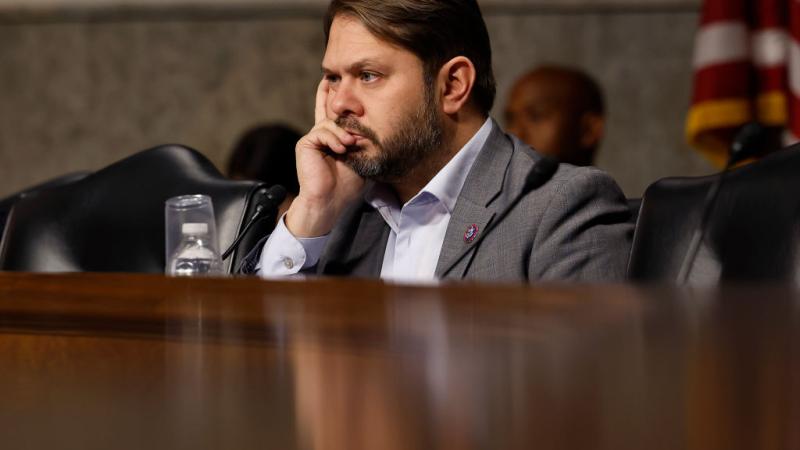
Taxpayer-funded science academy will keep controversial climate chapter in judicial training manual
The National Academies of Science, which received $200 million from federal agencies in 2024, refuses to remove a chapter about climate from a science manual provided to thousands of judges. Critics argue it is one-sided and biasing judges in climate lawsuits. A new study details the left-wing funding, and possible self-interest that the academies are promoting.
The National Academies of Science, Engineering and Medicine (NASEM) is refusing to remove a chapter about climate science from an influential training manual used by judges all across the country, possibly some involved in climate cases.
The manual is intended to be a neutral presentation of science to help judges involved in cases dealing with a range of issues where judges need to have some understanding of the underlying scientific principles of the case. The manual was created to bring judges up to speed on fundamental scientific understanding. Few — if any — federal judges are chemists, geologists or climatologists.
Undisclosed authors
A new report by the American Energy Institute (AEI), a 501(c)(3) tax-exempt organization focusing on energy policy, details how the authors’ associations to litigation and climate activism were never disclosed in the manual, which may be biasing judges overseeing climate cases in favor of the plaintiffs. The report also shows that NASEM receives hundreds of millions in taxpayer dollars.
Far from being a neutral presentation on climate science, the chapter on climate science was ghost-written by two anti-fossil fuel activists and a lawyer involved in climate litigation.
“The National Academies of Science have become completely corrupted by leftists,” Jason Isaac, CEO of the American Energy Institute, told Just the News. Besides receiving the $200 million in grants from the federal government, Isaac said, NASEM is granting some of that money to markedly leftist organizations.
In January, a coalition of attorneys general sent a letter to the heads of federal agencies raising concerns about the chapter, which was included in the fourth edition of the “Reference Manual on Science.” The manual is provided to thousands of judges and has been cited in over 1,700 opinions. It’s co-published by the Federal Judiciary Center (FJC) and the nonprofit NASEM, which owns the copyright.
NASEM won’t budge
Immediately after the letter was sent, the FJC agreed to “omit” the chapter, but it remains in the NASEM version. Last month, a separate coalition of attorneys general led by Montana Attorney General Austin Knudson, sent a letter to Secs. Pete Hegseth, Sean Duffy and Chris Wright.
That letter explains that Knudson’s office had communicated the issues with the text to NASEM, and NASEM President Marcia McNutt responded with a blunt refusal to remove the chapter. In her letter, McNutt offered no concessions, nor addressed the concerns about the chapter being written by activists and a litigant involved in climate lawsuits.
In their letter to the federal agency heads, the attorneys general argue that since the chapter fails to disclose that it was written by people with an interest in advancing climate cases in favor of plaintiffs, as well as failing to uphold ethical standards of objectivity, then NASEM should have its grants suspended and be barred from receiving government contracts.
Advocacy chapter
The chapter, “Reference Guide on Climate Science,” was authored by Jessica Wentz and Radley Horton, both of whom openly advocate for lawsuits to be filed against energy companies.
Wentz is a fellow at Columbia Law School’s Sabin Center for Climate Change Law, which states that its core mission is to “develop legal techniques to combat the climate crisis and advance climate justice, and trains the next generation of leaders in the field.” Together with Horton, Wentz co-authored a paper that advocates for climate litigation as a means to advance climate policy.
The chapter cites the work of Michael Burger, who is executive director of the Sabin Center for Climate Change Law and of counsel to Sher Edling, a law firm that specializes in climate litigation. The American Energy Institute report notes that he has appeared in or advised on climate cases in Hawaii, New York, Delaware and Maryland.
Dr. Roger Pielke, Jr., senior fellow with the American Enterprise Institute, conducted an AI analysis that compared the cited work by Burger with the text of the chapter. Pielke says that significant parts of the chapter were taken directly from Burger’s work.
Citations to other activists
The American Energy Institute report also notes that throughout the chapter are citations to climate activists, including an expert for climate plaintiffs and the founder of an organization that developed methodologies that would help advance plaintiffs' cases. It also cites the work of climate celebrity Michael Mann, who is well known for calling those with whom he disagrees as being “anti-science.”
Wertz and Horton published a 10-page defense of the chapter, insisting it is just a presentation of legitimate climate science. It defends the exclusion of research that contradicts the perspectives that are included in the chapter, arguing that these researchers are not “credible scientific authorities.”
The authorities Wertz and Horton have declared to be not credible include the authors of a Department of Energy climate assessment published last year. The authors include Dr. Judith Curry, president of the Climate Forecast Applications Network and author of "Climate Uncertainty and Risk;" Dr. John Christy, Alabama’s state climatologist at the University of Alabama Huntsville; Dr. Steven Koonin, who served as undersecretary for science at the Energy Department under the Obama administration; Dr. Roy Spencer, principal research scientist at the University of Alabama Huntsville; and Dr. Ross McKitrick, professor of environmental economics at the University of Guelph in Ontario, Canada.
Funding from climate advocacy and philanthropy groups
The $200 million that NASEM received in 2024 was 70% of its budget, and the rest includes millions from anti-fossil fuel groups. Among those funders is Sunflower Services (formerly Arabella Advisors), which has been described by critics as the “godfather of the left’s dark money. InfluenceWatch describes them as "a left-leaning philanthropic consulting company that provides strategy, advocacy, impact investing, and management services to high-dollar foundations, nonprofits, corporations, and individuals."
In 2018, NASEM received $575,300 from Arabella Advisors, according to the American Energy Institute report.
Over the years, ClimateWorks, another climate advocacy group, has granted over $1.5 million to NASEM. ClimateWorks is a primary funder of Energy Foundation China, which has ties to the Chinese government and coordinates with the Chinese Communist Party. The William and Flora Hewlett Foundation, the David and Lucile Packard Foundation, and the McKnight Foundation created ClimateWorks in 2008 to combat climate change through philanthropy.
Other anti-fossil fuel donors to NASEM include the George Soros-backed Tides Foundation, and the Rockefeller Family Fund.
The American Energy Institute report also lists grants that NASEM made to climate and environmental groups, including the Environmental Defense Fund, the National Wildlife Federation, and the Louisiana Environmental Action Network.
"The climate fox is guarding the judicial hen house," AEI says
Climate activists have worked actively to advance their perspectives through materials and training provided to judges. This includes the Climate Judiciary Project, an initiative by the Environmental Law Institute (ELI), which was the subject of a Congressional probe.
Critics point out that, like the NASEM science manual, the trainings that the Climate Judiciary Project provides are developed by activists who advocate for climate litigation, and the materials are tailored to present only scientific perspectives favorable to plaintiffs in climate cases.
The ELI contends the CJP trainings are not biased and are a presentation of the most authoritative science available.
While the Federal Judiciary Center was quick to remove the chapter, many are asking how material developed by climate activists and a climate litigant ended up in an authoritative manual, which should have considerable oversight to ensure the included material is neutral.
“The climate fox is guarding the judicial hen house,” Isaac with the American Energy Institute said.
NASEM did not respond to requests for comment on the report and points made by critics of the climate chapter.
The Facts Inside Our Reporter's Notebook
Links
- new report
- coalition of attorneys general sent a letter
- Reference Manual on Science
- âomitâ the chapter
- sent a letter
- blunt refusal
- core mission
- paper that advocates for litigation
- specializes in climate litigation
- Pielke found
- anti-science
- 10-page defense
- Climate Forecast Applications Network
- Climate Uncertainty and Risk
- Dr. John Christy
- Dr. Steven Koonin
- Dr. Roy Spencer
- Dr. Ross McKitrick
- described by critics
- Chinese Communist Party
- subject of a Congressional probe



Top Stories





Trending
Just the News Spotlight
Just News, No Noise