Major barriers to MAGA’s dream of manufacturing revival? Skilled workers and will to do the job
There is light at the end of the tunnel. Data show interest in the trades, which are vital to a manufacturing revival, could be returning.
President Donald Trump’s signature economic and trade policies, by and large, are geared toward spurring a manufacturing revival in the United States.
However, even as foreign investment flows in and tariffs purportedly rebalance the trade deficit, manufacturers are having trouble hiring skilled workers to fill the over 400,000 open jobs across the country.
CEOs and industry experts point to two major barriers: a lack of a skilled or trained workforce and a “will gap,” or lack of willingness to engage in the work required for these jobs – and have been warning about these barriers for years.
“We are in trouble in our country. We are not talking about this enough,” Ford CEO Jim Farley said in a recent interview on the “Office Hours: Business Edition” podcast. “We have over a million openings in critical jobs, emergency services, trucking, factory workers, plumbers, electricians and tradesmen.”
At Ford, Farley said the company has 5,000 open mechanic jobs, but is struggling to fill them. The roles come with a $120,000 salary, nearly double the approximate median salary of $62,000 in the United States.
“It’s a very serious thing,” he added.
The U.S. has over 400,000 open manufacturing jobs, according to the U.S. Bureau of Labor Statistics.
Despite openings being down from about 100,000 at the beginning of the year, the gap remains relatively consistent with the one that existed before the onset of the COVID-19 pandemic, which upended the manufacturing labor market.
Farley believes the primary reason for the gap is a lack of proper education and training.
“We do not have trade schools,” he said. “We are not investing in educating a next generation of people like my grandfather who had nothing, who built a middle-class life and a future for his family.”
The Ford CEO is not alone in his assessment.
Last year, a study of the manufacturing sector by the consulting firm Deloitte and The Manufacturing Institute found that “workforce issues” remained a leading concern for the manufacturing industry. The survey of U.S. manufacturers and executives in particular identified simultaneous company growth, changing skills, and a lack of candidates as the driving forces behind the vacancies.
“Attracting and retaining talent is the primary business challenge indicated by over 65% of respondents in the National Association of Manufacturers’ (NAM) outlook survey for the first quarter of 2024,” Deloitte said of the study.
The findings align with what Mike Rowe of Dirty Jobs TV series fame has been telling Congress and the public for years.
In 2008, Rowe started the mikeroweWORKS Foundation, which aims to restore American interest in skilled labor, inspire young people to pursue trade and vocational schooling, and provide scholarships for such education.
As early as 2011, he testified before the House Transportation and Commerce Committee warning of the growing “skills gap” in America. When he returned in 2017, he noted that since he last appeared the “skills gap had gotten even wider, tuition got even more expensive, and guidance counselors continued to use a career in the trades as a ‘cautionary tale’ for those who resisted a four-year degree.”
More than just a lack of education and opportunity, Rowe says that America’s younger generations have an “undeniable lack of will” to do the kinds of jobs necessary to reinvigorate the American manufacturing base.
There’s a powerful and logical assumption that unemployment can be remedied with more opportunity. But the skills gap proves that opportunity is not enough to get people working,” Rowe said in his 2017 testimony.
“And while more and better training is certainly part of the solution, that’s not enough either. Because underneath the lack of skill, is an undeniable lack of will. A lack of enthusiasm,” he continued.
“When we took shop class out of high school, we sent an unmistakable message to an entire generation of students. We told them – no, we showed them – that a whole category of jobs was simply not desirable,” Rowe concluded. “Is it any wonder, those are the very jobs that go begging today?”
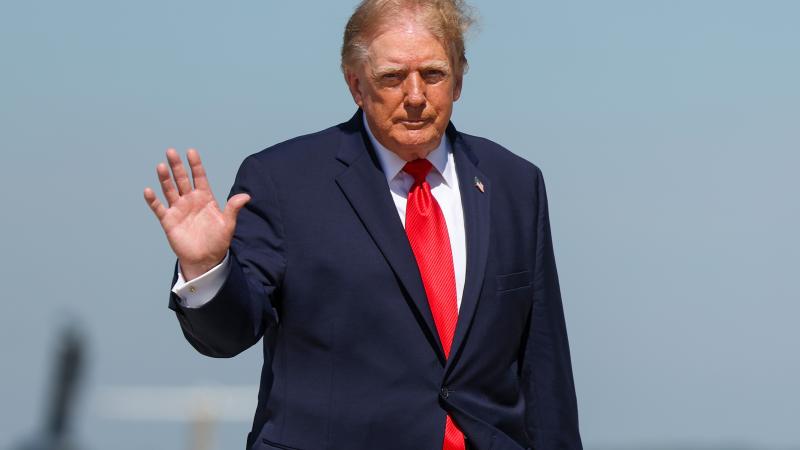
President Trump seems to understand this dynamic. During his first and second terms he has promoted trade apprenticeship programs and vocational schooling as an alternative to the standard four-year college degree.
Recently, the president faced backlash from some conservative allies after he said in an interview that America needed some foreign workers to fill roles in new high-tech manufacturing projects because there are not enough skilled workers in the United States.
“[You] don’t have certain talents, and people have to learn. You can’t take people off an unemployment line and say, ‘I’m going to put you into a factory where we’re going to make missiles,’” Trump said in an interview with Fox News’ Laura Ingraham.
The president later explained his comments at the U.S.-Saudi Arabia Investment Forum in Washington, D.C.
“They just don’t understand,” Trump said of the critics. “People have to be taught this is something they’ve never done. But we’re not going to be successful if we don’t allow people that invest billions of dollars in plants and equipment to bring a lot of their people from their country to get that plant open, operating and working. I’m sorry.”
There are signs that interest in the trades, which are vital to a manufacturing revival, could be returning. Data show that in recent years enrollment in vocational training programs has been surging exponentially. The most recent study from the National Student Clearinghouse found enrollment at these institutions has grown “ by almost 20% since the spring of 2020.”
Companies are also investing in training programs and boosting wages in an attempt to recruit workers.
"The four-year degrees are trending down in [the Gen Z] cohort," Rowe told Fox Business earlier this year. "There’s a lot more interest in electricians, and plumbers, and steamfitters, and welders and pipefitters."
The Facts Inside Our Reporter's Notebook
Links
- âOffice Hours: Business Editionâ podcast
- the approximate median salary
- more than 400,000 open manufacturing jobs
- a study of the manufacturing sector
- Deloitte said of the study
- he returned in 2017
- Rowe said in his 2017 testimony
- faced backlash from some conservative allies
- said of the critics
- National Student Clearinghouse found
- investing in training programs and boosting wages
- Rowe told Fox Business



Top Stories



Trending
Just the News Spotlight
Just News, No Noise