Michigan sued for forcing pro-life groups to hire pro-abortion staff, provide abortion insurance
Federal appeals court reinstated lawsuit against New York's similar law a year ago. Michigan pro-life pregnancy center fears it can't even deny volunteers who support abortion, under public accommodation law.
A year after a federal appeals court reinstated a lawsuit against New York for forcing pro-life organizations to hire people at odds with their "very mission," their peers across Lake Erie are hoping to carry forward the legal momentum against Democrat-led states that seek to deputize pro-life organizations into furthering abortion.
Right to Life of Michigan and Pregnancy Resource Center sued state officials to stop a law that not only forces them to hire supporters of abortion rights but also include abortion in their health insurance plans, under a novel definition of sex discrimination.
Like New York's 2019 law prohibiting "discrimination based on an individual's or a dependent's reproductive health decision making," Michigan's 2023 law added "termination of a pregnancy" to the definition of "sex" in the state's employment discrimination law, removing an exclusion for "nontherapeutic abortion not intended to save the life of the mother."
A subsequent bill signed into law by Democratic Gov. Gretchen Whitmer repealed Michigan's Abortion Insurance Opt-Out Act.
"People" formerly had to "buy a separate insurance rider for abortion ... just in case they were assaulted," Whitmer's press release said, omitting females as the only sex capable of pregnancy and characterizing failure to cover abortion as a disservice to rape victims.
"Now, it is illegal to 'refuse to hire or recruit,' 'discriminate,' or 'deprive' applicants of an 'employment opportunity' because of their support for, or decision to have, an abortion," the lawsuit says. Employers cannot explain their pro-life requirements to applicants or ask them for their views, and must cover abortion if they "generally" offer insurance.
"Because they won’t, they risk severe penalties, like five-figure fines, loss of state-issued licenses, and more," says the lawsuit, whose allegations include violations of First Amendment rights to "expressive association and assembly," freedom of speech, press and free exercise, and 14th Amendment due process for vagueness and forced taking of human life.
The Alliance Defending Freedom is representing plaintiffs in both New York and Michigan challenges.
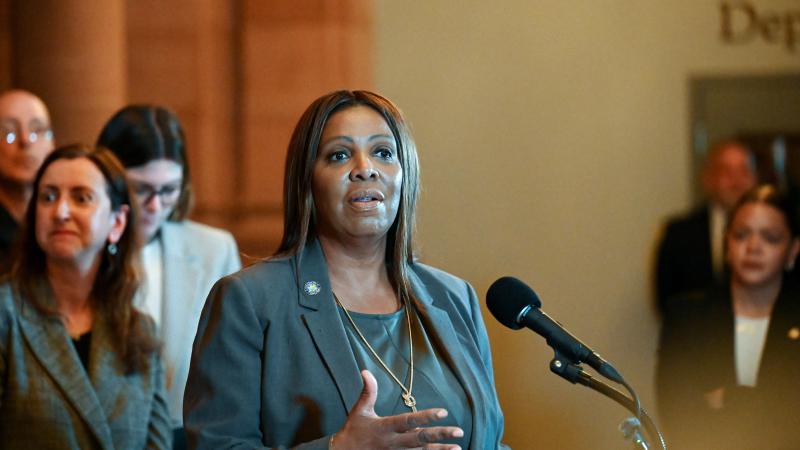
The office of Michigan Attorney General Dana Nessel, the lead defendant, did not answer queries Monday and Tuesday by Just the News for its response to the suit, including how case law differs between its binding jurisdiction of the 6th U.S. Circuit Court of Appeals versus the 2nd Circuit, which reinstated the lawsuit against New York in 2025.
Seeking exemption risks state investigation
The first half of the 82-page complaint is dominated by the plaintiffs' missions and descriptions for each staff position, including senior executives, communications personnel, administrative support, lobbyists and medical professionals, as well as how they use volunteers.
Right to Life employs about 40 people and hires four a year on average but "regularly receives between 15 and 75 applications for a single open position." Only 10% typically responded to its automated email asking applicants to review the organization's mission and values, and some of those expressed disagreement, the suit says.
One applicant for a legislative position listed "Planned Parenthood advocacy" as work experience, and another who made it through to an in-person interview said abortion was a personal choice and even described herself as "pro-abortion."
Right to Life recently edited its automatic email to no longer ask candidates to share their thoughts "on its pro-life mission and values," given the "substantial risk of investigation and prosecution" under the amended law.
PRC has more than 40 employees and hires eight to 12 annually but "typically receives 20 to 70 applications for a single open position," the suit says. It asks those deemed qualified to "acknowledge" its "Stated Doctrines," at which point "applicants frequently decline to respond" or withdraw themselves out of disagreement with the doctrines.
Both organizations would like to make their job descriptions, applicant procedures and benefits packages even more explicit about their mission and values, but for Michigan law.
"Because of the severely intrusive nature of Michigan’s investigatory process" when organizations seek a "bona fide occupational qualification" exemption to the new definition of "sex," the "fear of going through this process has forced PRC and Right to Life to refrain from amending their job posting and reposting amended versions on their websites," the suit also reads.
Not only does the Michigan Civil Rights Commission limit religious BFOQs to "positions that are directly and exclusively responsible for teaching religious doctrine," but the plaintiffs would be expending substantial resources with no guarantee of success while putting a target on their backs, the suit says.
They would have to hire a lawyer or divert staff to draft and submit "new and independent applications for each existing position and for each new job posting," seeking renewal every five years, and get Michigan's permission before promoting new openings, the suit says.
The commission has no "set deadline" to answer requests and can revoke granted exemptions on vague grounds at any time, while it has "authority to independently investigate employers and initiate complaints against them" when it receives BFOQ requests, according to the suit.
Pro-life organizations are uniquely burdened by the law, which gives preferential treatment based on disability, age, "employment by family members" or simply employing fewer than 50 people, the minimum for mandatory health coverage, the suit says.
By forcing them to cover abortion in their healthcare plan, the law makes the plaintiffs "less desirable by undermining their moral credibility and institutional reputation as pro-life advocates" and inhibits "effective recruitment" because the law prohibits them from "consistently embody[ing] the values they promote."
It explicitly discriminates by viewpoint by applying no burdens on Planned Parenthood of Michigan's lobbying, job recruiting and conditions on its own employees to match the abortion provider's mission and values, putting pro-life organizations "at a competitive disadvantage" to their opponents.
Some of the allegations are specific to PRC, which unlike Right to Life is faith-based. It "appears" to qualify as a place of public accommodation and public service provider under state law, meaning it cannot require volunteers – the lifeblood of pro-life pregnancy centers – "to agree with or abide by PRC’s Positions."
A clause in the public accommodation law prohibits providers from publishing any statement that "indicates" a person's presence at the establishment is "objectionable, unwelcome, unacceptable, or undesirable" based on sex, but nowhere defines these terms, and a commissioner testified under oath he had no idea what they mean, the suit says.
The Facts Inside Our Reporter's Notebook


Top Stories





Trending
Just the News Spotlight
Just News, No Noise