Related Articles




Former President Joe Biden paused liquified natural gas exports while the Energy Department completed a study to see if increased exports were in the public interest. The study, released over a year ago, predicted exports would drive up domestic prices. The exact opposite has happened.
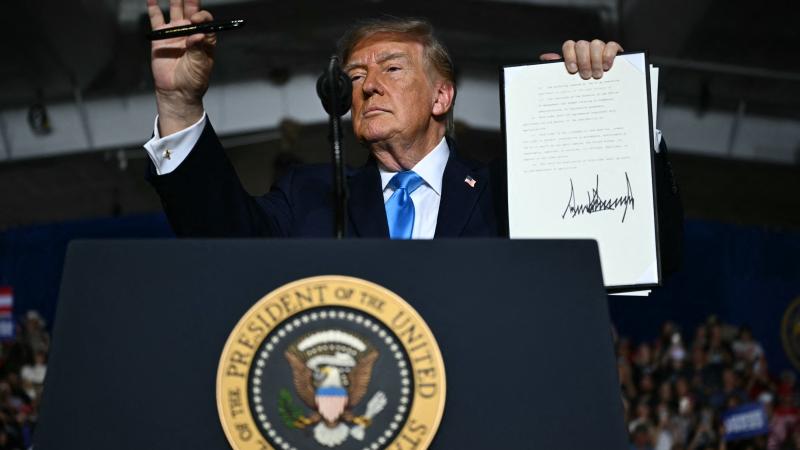
The Trump administration had its one-year anniversary Tuesday, and the White House marked the occasion with a list of 365 actions that the administration has taken — what it calls “wins” — since President Donald Trump assumed office.
Among these are the nearly three dozen actions the administration took to unleash “American Energy Dominance.” Among the lists of “wins,” Trump took credit for record-high increases in LNG exports. The U.S. is the first country in history to export more than 100 million metric tons of LNG in a single year, the White House noted.
Two years ago, the Biden-Harris administration announced it was pausing LNG exports while it conducted a study to see if it was in the public interest to increase exports. Climate activists had pushed the administration to stop LNG export expansion, arguing it would increase domestic prices and make global warming worse.
Then-Energy Secretary Jennifer Granholm released a study the following December, and its conclusions were in line with what activists had wanted to see. The study found that “unfettered” exports of LNG would increase wholesale domestic natural gas prices by more than 30%, costing the average American household well over $100 more per year by 2050.
The study also claimed that U.S. LNG exports would displace more renewables than they would displace coal, resulting in an increase in greenhouse gas emissions.
By the time the study was released, Trump had won the election. He immediately resumed export permits upon taking office. One year later, the Biden-Harris administration’s conclusions are turning out to be inaccurate.
The Biden-Harris administration study operated on the assumption that the world could be efficiently powered by wind and solar, meaning natural gas exports would be a roadblock in transitioning to those alternative technologies. However, the data doesn’t show that wind and solar are becoming a large portion of the energy mix, despite trillions of dollars in investments.
The Energy Institute’s 2025 Statistical Review of World Energy reported that in 2024, only 3% of global primary energy — which is energy in raw form directly from various sources such as coal or sunlight — came from wind and solar. Coal, natural gas, oil and other hydrocarbons provided 81%.
That’s down from 87% in 2004. Last year alone, the globe spent $2.1 trillion on the so-called energy transition, according to BloombergNEF.
In Europe and the United States, natural gas has replaced much coal-fired electricity generation. Because natural gas produces less greenhouse gas emissions than coal, it’s brought down U.S. emissions, and while LNG exports have been increasing since 2016, there’s been no long-term trend toward higher prices in that time.
“American natural gas commodity prices remain relatively low and stable even as our LNG exports shatter global records due to robust supply, extensive gas pipelines, and storage infrastructure capable of meeting rising demand both for domestic use and exports,” Karen Harbert, president of the American Gas Association, told Just the News.
While the Biden-Harris administration’s Energy Department completed its study, the House Oversight Committee learned that the department had previously completed a study on LNG exports. In a letter to Granholm, Committee Chair Rep. James Comer, R-Ky., Rep. Pat Fallon, R-Texas, and Rep. Clay Higgins, R-La., said that the DOE had never mentioned or provided this draft study in communications with or hearings before the House Oversight Committee.
In December of 2024, Brad Crabtree, who was at the time the Assistant Secretary for Fossil Energy and Carbon Management at the DOE, testified at an Oversight Committee hearing that he wasn’t aware of any completed study in 2023. This past March, Energy Secretary Chris Wright confirmed that the study the Biden-Harris administration had long denied existed did, in fact, exist.
Climate activists like Bill McKibben, founder of 350.org, pressed the Biden-Harris administration to restrict LNG exports. A few months before former President Joe Biden announced the pause on export permits, in a New Yorker editorial, McKibben cited the work of Cornell Professor Robert Howarth, whose research had concluded that LNG emits more greenhouse gases than coal.
Howarth’s had a history of producing studies that were outliers among other research finding LNG lowers emissions. A Breakthrough Institute analysis of the study McKibben cited found it to be riddled with errors. Howarth disputed the institute’s analysis and stood by his work.
Tom Shepstone, who ran "Natural Gas Now" for years before moving his work to "Energy Security and Freedom" on Substack, said a lot of this kind of research is “propaganda.”
“We see so much of this with a lot of really junk science out there. It's just everybody wants to propel a narrative, and they do the studies to support the narrative,” Tom Shepstone told Just the News. Shepstone said it’s not uncommon for all kinds of advocacy groups to produce research supportive of their position. The problem with research into climate change is the media’s rush to report findings supportive of the “climate crisis” narrative without scrutiny.
“They always accept the research uncritically without asking any tough questions,” Shepstone said.
While Granholm's study predicted that LNG exports would drive up domestic gas prices, data from the past year, as well as the last 20 years, shows the exact opposite has occurred. "Exports of LNG grew from 186.8 billion cubic feet in 2016 to 4.3 trillion cubic feet in 2024, according to the Energy Information Administration."
Despite this increase, inflation-adjusted natural gas prices are a fraction of what they were 20 years ago. In January 2004, the inflation adjusted price at the U.S. Henry Hub was $10.15 per British Thermal Unit. Last month, they were down to $4.00 per BTU. The Henry Hub is the main natural gas hub in the US. It connects more than a dozen interstate and intrastate pipelines from Louisiana, Texas, and the Gulf of Mexico.
Cold weather is shrinking supplies and driving up prices this week in the U.S. and in China, but inventories in the U.S. aren’t critically low, according to oilprice.com. Globally, LNG output is expected to jump this year, which will depress gas prices through 2026 and create more demand in emerging economies, analysts told Reuters.
Jason Isaac, founder and CEO of the American Energy Institute, said the concern about price increases was an activist strategy to help advance restrictions on LNG exports.
“The climate alarmists have been wrong about LNG exports for decades. We're supplying affordable, reliable energy for our friends and allies around the world. This has been good for producers in the U.S.”
Harbert with the American Gas Association said that with the robust natural gas resources and infrastructure in the U.S., exports won’t create supply issues that would drive up costs.
“With vast supplies of natural gas, more than 2.8 million miles of existing pipeline networks and extensive storage systems, we don’t have to choose between meeting global market demand and keeping costs affordable for Americans. We can do both – and we are,” Harbert said.
Kevin Killough is the energy reporter for Just The News. You can follow him on X for more coverage.