Related Articles

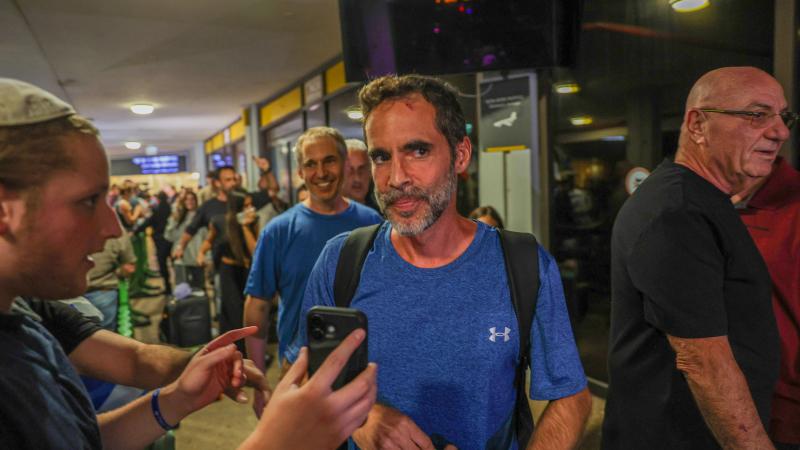

Historian Victor Davis Hanson rejects the idea America is in "quagmire" with Iran, predicting that Trump will systematically cripple Tehran's infrastructure before shifting the burden of securing the Strait of Hormuz to allies
Rejecting claims that the U.S. is trapped in a "quagmire" with Iran, historian Victor Davis Hanson predicted Thursday that President Donald Trump will systematically cripple Tehran’s infrastructure before shifting the burden of securing the Strait of Hormuz to oil-dependent European and Asian allies.
“He’s going to respond disproportionately,” Hanson, a senior fellow in military history at the Hoover Institution at Stanford and professor emeritus of classics at California State University, Fresno, said on the John Solomon Reports podcast.
“I think he will look at the rail bridge to China that he's taken out," he continued. On Thursday, the U.S. struck the strategic Ogtay Khan railway bridge in northern Iran which connects it to China and Russia, accoring to Iran's semi-official Fars News Agency.
"I think he'll look at the Caspian Sea ports, where they trade with Russia. I think he'll look at a lot of their power generation, and he's basically going to make it impossible for them to trade and import and export for a long time,” Hanson also said.
His comments follow U.S. forces on Wednesday launching a second round of strikes on Iran – hitting roughly 90 Iranian military targets.
U.S. Central Command said that the operation was “to impose heavy costs for Iran violating the ceasefire,” following Iran’s attack on three commercial vessels in the Strait of Hormuz, a key international shipping channel for oil and natural gas.
Iran has launched retaliatory strikes targeting U.S. military sites across the region in Bahrain, Kuwait, Qatar, and Jordan.
Trump had also said Wednesday during the NATO summit in Turkey that the ceasefire was over, and that he was not sure he wanted to make a deal with the Iranians.
“As far as I’m concerned, it’s over,” he said, while also calling Iran’s leaders “sick,” and saying that dealing Iran was “a waste of time."
To these developments, Hanson said that Trump had "basically destroyed the military industrial nuclear complex of Iran for at least 10 years,” and that initially, the president had “thought rather than just obliterate the nation's ability to function, he would give them a chance to negotiate.”
"And that window was closed, and they missed the opportunity," Hanson said. Hanson dismissed the idea that the U.S. was mired in a “forever war with Iran."
He noted that for the past 47 years, since the 1979 Iranian Revolution, people had been told that Iran was untouchable, with the narrative that warned Iran is of a nation with 93 million people, has the fourth-largest oil reserves in the world, a radical Shia theocratic movement and backed by terrorists who have killed more Americans than any other group, “except for 9/11.”
“Today, as we look at them, they are the weakest point economically, militarily, and industrially than they've been in that regime's 47-year history, so it's been, in a geostrategic sense, a very changed world,” he said.
Hanson predicted that Trump’s goal is to cripple the regime’s economic spine, hand the onus of securing the Strait of Hormuz to the European and Asian countries dependent on its oil, and ultimately bring American troops home.
“I think he's going to go home, and he's going to tell the Europeans and our allied Asian countries that now this country is defunct, and we'll leave a vestigial force here to help you organize, but the onus is on you people to keep the Strait of Hormuz open,” he said.
Hanson made the prediction as the United States' midterm elections are now just a few months away, with energy costs being a concern for voters. Still, he predicted that there would be a “glut” by October, with the price of gas “at or below 3 dollars.” According to data released by the American Automobile Association on Thursday, the national average for a gallon of regular gasoline was $3.84.
“Everybody's pumping more oil. UAE is out of OPEC, and China is buying less oil. Russia is producing more, Venezuela is producing more, we're producing more,” Hanson said, adding that there were also “200 or so tankers” currently full of oil. Ship-tracking data analyzed by BBC Verify in June shows that more than 200 tankers were waiting inside the Strait of Hormuz, while the renewed strikes have since caused many commercial vessels to divert or slow their transits.
Hanson said that the American people want "two things" and expect them to be "complementary, not one or the other.”
“They want to get out of that mess, and they want to win and defeat that awful regime, and I think he can do both," he said.