Trump, Xi meeting to be packed with slew of hot topics
While the two countries are often seen at odds, Trump maintains he has a good relationship with Chinese President Xi Jinping.
(The Center Square) -
After postponing a scheduled trip to China from March to May due to the U.S. strikes on Iran, President Donald Trump is set to visit the country for the first time since 2017 and is heading into the meeting with a long agenda.
While the two countries are often seen at odds, Trump maintains he has a good relationship with Chinese President Xi Jinping.
The two leaders are expected to cover several topics during the two-day visit, including trade, technology, human rights, security and Iran.
The president heads into the meeting with a trade deficit with China of $202.1 billion in 2025, according to the Office of the United States Trade Representative. China is the third-largest trade partner with the U.S. Trump has tried to close that gap with his tariffs, but has run into legal roadblocks in court over the legality of his tariff policies.
Last fall, when the two leaders met, they agreed on a handful of key trade issues, including China’s purchase of American soybeans and a rare earth deal.
Trump has even proposed establishing a Board of Trade between the two nations to address the trade deficit, among other things.
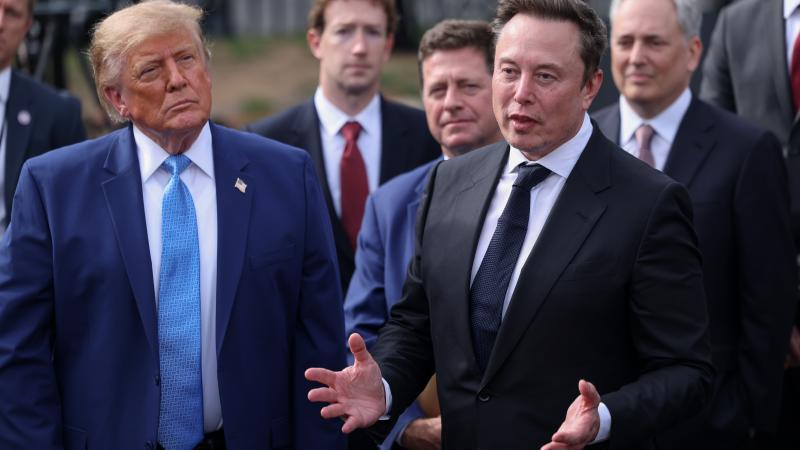
Aside from trade, technology will likely be another top issue during the visit, with the U.S. and China locked in a race for artificial intelligence. Trump is reportedly inviting several tech CEOs to attend meetings with the leaders.
Despite trade being a top issue with China, Iran and Russia, particularly Iran, will likely be a topic of discussion as China has been aligned with the Islamic Republic.
Before the U.S. Naval blockade of Iranian ports, China was Iran’s largest oil customer, accounting for about 90% of Iran's oil exports, according to the U.S.-China Economic and Security Review Commission.
Iranian crude oil accounts for about 12% of China’s total crude oil imports, according to the Center for Global Energy Policy at Columbia. However, China imports nearly half of its crude oil from Middle Eastern countries, including Saudi Arabia, United Arab Emirates, Oman, Kuwait and Qatar.
With nearly 50% of China’s crude oil imports relying on transit through the Strait of Hormuz, Trump will likely lean on China’s influence with Iran to put pressure on the Islamic Republic to clear the vital waterway.
The president could also use the visit to discuss China’s reported military support of Iran. In April, the president wrote in a Truth Social post that “China have agreed not to send weapons to Iran," however, following the implementation of the blockade on Iranian ports, U.S. forces intercepted a ship inbound for Iran carrying what Trump describes as a “gift” from China to Iran.
Trump told reporters he was “a little surprised” at China after what he thought was an “understanding” with Xi.
When Trump and Xi met last fall, Trump made fentanyl a key focus of their meeting. Before the meeting, the president imposed a 20% tariff on China for not taking adequate action to curb the production of the chemicals to make fentanyl.
Following the meeting, the president felt confident that China would curb the flow of trafficked chemicals, so he sliced the tariffs in half to 10%.
Trump also has vowed to bring some of China’s human rights abuses back into the spotlight, with the imprisonment of political prisoners. The president has vowed to address the imprisonment of high-profile individuals, including Ezra Jin Mingri, a Christian pastor; Hong Kong political activist Jimmy Lai; and Gulshan Abbas, a Uyghur doctor.
The leaders are scheduled to meet in Beijing May 14-15. Trump previously indicated Xi plans to travel to the U.S. for another meeting.

Top Stories




Trending
Just the News Spotlight
Just News, No Noise