
Drones are a ‘rapidly evolving’ threat to U.S., and developing countermeasures poses challenges
The Department of War has known for years that drones present a unique threat on the modern battlefield and for domestic security. Experts say that effective countermeasures require a "system of systems" approach, and some technologies are showing promise.
Iran’s Shahed-style drones each cost between $20,000 and $50,000, but they can do a lot of damage. Since the latest conflict began, Iran's drones have killed six members of the Army Reserve at a command center in Kuwait on Sunday, and Iranian drones have wreaked havoc on Middle East petroleum facilities.
The FBI is now warning that Iranian drones potentially pose risks to targets in California. Some journalists in the legacy media are shocked to discover that the U.S. has limited capabilities to counter these destructive and lethal aerial devices. While it's true that neutralizing drone threats is difficult, it’s a problem the Department of War has been aware of and working to address since long before the conflict in Iran.
Nearly twenty years ago
In 2007, Tom Rullman, president and CEO of GT Aeronautics, ended up sharing a cab ride with a two-star general in Washington, D.C. GT Aeronautics develops a variety of drones for commercial and defense purposes, and in 2006, it was developing a drone with air to ground capabilities, called a Bandito. The small devices have a wingspan of 16 inches, weigh less than two pounds, and fly at 200 miles per hour.
During the chance encounter with the general, Rullman discussed the Bandito and showed him charts of the drone. The general was very interested in the technology and invited Rullman to brief the Air Force at the Pentagon on what his Banditos could do.
Image
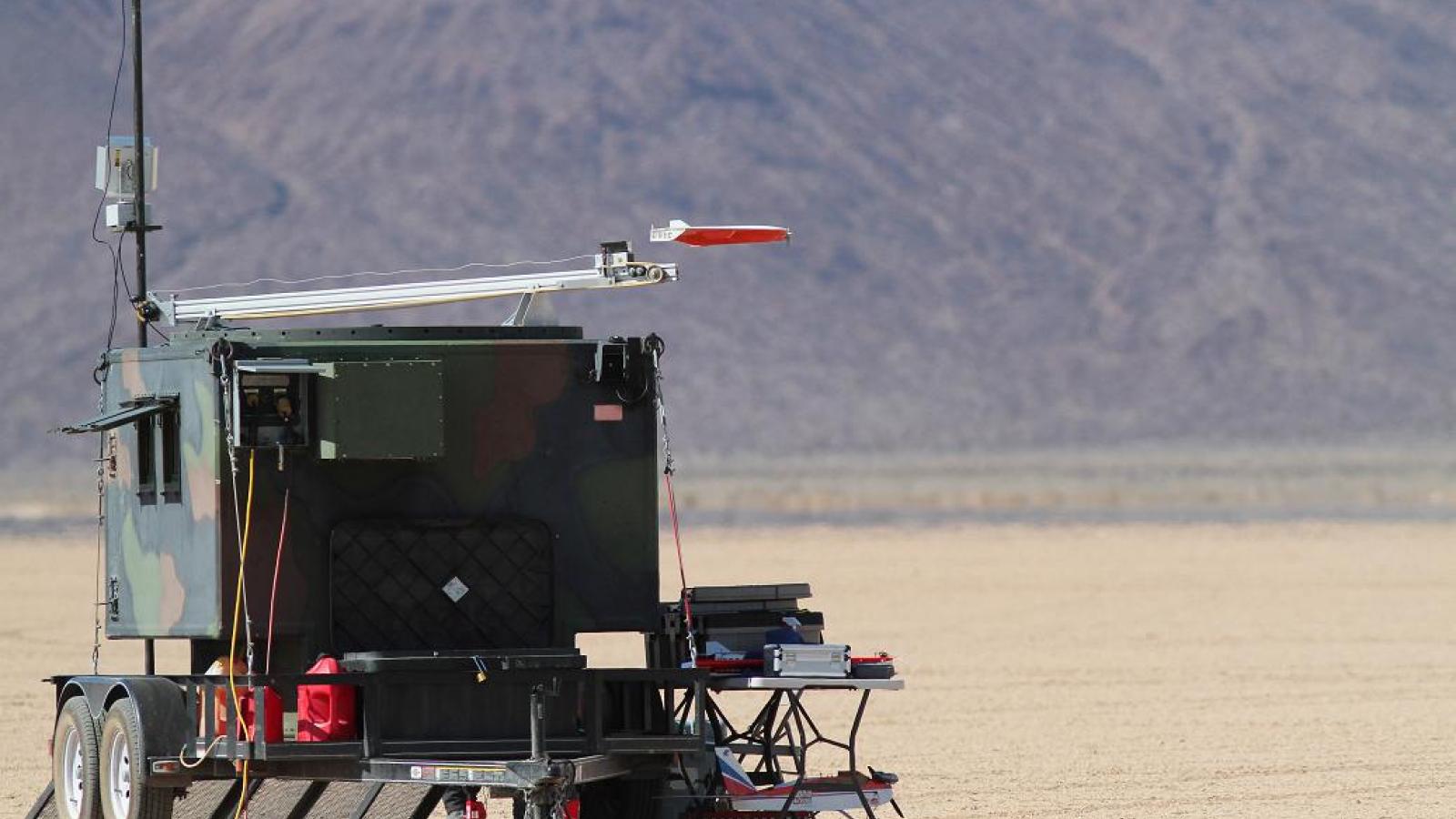
A 'Bandito' is fired from a command center during a test in Southern California.
(Courtesy GT Aeronautics)
“There were like 40 generals in the room, and I had a 20-minute time slot. That brief turned into three hours,” Rullman told Just the News. Among the questions the generals asked Rullman was if his Banditos could be used to, say, attack the White House.
“Absolutely,” Rullman told the generals. “We can launch a Bandito outside the window of a truck that's moving, do it 20 miles away and send it to a target on the ground.”
That got the Pentagon’s attention. The government asked GT Aeronautics to help develop drones that could take out air targets. By 2009, Ruleman was flying Banditos out in the California desert near Point Mugu Naval Air Station and developing the systems that allow them to track targets.
A defining feature of modern warfare
Col. Guy Yelverton is a project manager for the U.S. Army’s counter-unmanned aircraft system (UAS) — what the military and FAA call drones. Yelverton said the Department of War is actively working to address the risk that drones are posing to U.S. troops. The U.S. military has seen a proliferation of low-cost adversarial drones in recent years, and they range from small, commercial-style drones to larger, more capable platforms. “They’re becoming a defining feature of modern warfare,” Yelverton told Just the News.
These drones increase the ability of our adversaries, as well as “non-state actors,” to conduct reconnaissance, targeting and harassment with little risk to their own personnel, Yelverton said.
“They can make a drone pretty cheaply and then hang something off of it that could do some damage,” Yelverton said.
On the battlefield, adversaries’ use of drones provides them with persistent surveillance and enables rapid strokes. This presents a situation for U.S. troops where decision-making timelines are severely compressed.
Unleashing American drone dominance
In his second term, President Donald Trump recognized the need for better counter-UAS technology. In June, he signed the “Unleashing American Drone Dominance” executive order. The order accelerates commercial drone technology development, but it also contains provisions to facilitate programs for counter-UAS development.
In August, the Department of War established the Joint Interagency Task Force 401 (JIATF-401), which aims to rapidly deliver counter-UAS capabilities to the U.S. military. Yelverton, who is involved in the JIATF-401 program, has been working in counter-UAS capabilities for over two years. He said he’s in meetings every week at various levels of the Department of War that look at options.
Members of Congress are also looking into the issue. In June, Rep. Harriet Hageman, R-Wyo., toured the GT Aeronautics facilities at the Powell Municipal Airport in Powell, Wyoming. “It is great to see a company dedicated to producing remotely piloted and unmanned aircraft systems using 100% USA-made components,” Hageman said on X.
The challenges of countering drones
Yelverton said there are three main challenges to developing effective systems to counter drone threats. The first is detecting and identifying drone threats at scale. Small drones can be difficult to detect in a cluttered environment, and then, once identified, the intent of the drone has to be determined. When a drone is determined to be a threat, the response requires a quick decision to determine how to engage and neutralize the target.
The other aspect of a good counter-UAS system, Yelverton explained, is cost and capacity. Using million-dollar missiles to destroy or disable cheap drones that are sometimes deployed in large quantities isn’t a sustainable long-term solution.
“We're constantly looking at how we can manage the cost of an interceptor, especially when you start thinking about mass threats,” Yelverton said.
Video file
The other aspect of a good counter system is integration. Yelverton called it a “system of systems.”
This requires a detection system, a command and control system to decide how to defeat a threat, and then a determination of the best means to address such a threat, whether it be electronic warfare, a kinetic option such as bullets, or possibly directed energy, such as lasers or microwaves.
“I need to sense, decide and act. And I need to bring all that together in a system of systems. But then I also need trained operators to be able to support all that,” Yelverton explained.
Yelverton said that a good counter-UAS that discerns a threat will require the processing of a lot of information at once. Artificial intelligence might be one tool that can help. It wouldn’t do the work of the operators, he said, but it would give the operators choices to make decisions quickly.
Yelverton said the Department of War is also looking at systems that can easily integrate into the systems of all branches of the military and the Department of Homeland Security.
“We're collaborating, but there are pieces and parts. They work together. We can plug and play together,” Yelverton said.
Drones create threats at home
The attempted assassinations of President Trump and the murder of Charlie Kirk resulted in widespread praise for the perpetrators on social media. That shows that there are people here in the U.S. who are quite comfortable killing those with whom they disagree. It’s not hard to imagine a terrorist using a drone to target a crowd with a pipe bomb.
Electricity-grid infrastructure is also vulnerable to drone attacks, and U.S. bases could become targets. Last month, there were reports of hundreds of drone incursions over U.S. military installations, and the Pentagon expanded base commanders’ authority to respond to potential threats. No one is entirely sure what the intent of all drones has been.
Rullman said that the ability to reach malicious drones at range is important, so expanding the commanders' authority to respond outside the base perimeter was a good move. “Most of the engagements are happening right overhead, which is kind of too late. If it's dropping a grenade on you, that's too late,” he said.
The Bandito satisfies many of the aspects of counter-UAS technology that the military needs, Rullman said, and he is hoping that his designs can satisfy the military's needs for effective counter-UAS.
During tests in the California desert, the Bandito was able to get within 18 inches of its targets that were 50 miles away. The targeting system uses existing radar, so it can be integrated into existing air defense systems. The drones are cheap, and every military base could stock thousands of them for costs in the millions of dollars, Rullman said.
"If someone shot 300 drones, and we shot 300 Banditos to take them down, we'd only use up 1/6 of our inventory of munitions," he said.
Kevin Killough is the energy reporter for Just The News. You can follow him on X for more coverage.
The Facts Inside Our Reporter's Notebook
Videos
Video file
Links
- $20,000 and $50,000
- Iran killed six members
- wreaked havoc
- pose risks to targets in California
- legacy media are shocked to discover
- GT Aeronautics
- Bandito program
- Col. Guy Yelverton
- Unleashing American Drone Dominance
- Joint Interagency Task Force 401
- Hageman said on X
- fired over 100 drones at Israel
- Electricity-grid infrastructure
- hundreds of drone incursions
- Pentagon expanded
- No one is entirely sure
- follow him on X
Other Media
Image
A 'Bandito' is fired from a command center during a test in Southern California.
(Courtesy GT Aeronautics)




Top Stories




Trending
Just the News Spotlight
Just News, No Noise