Bhattacharya goes from US health policy outsider to leading top agencies at Trump's personal request
Prior to the COVID-19 pandemic, Bhattacharya was a medical doctor and professor at Stanford University,
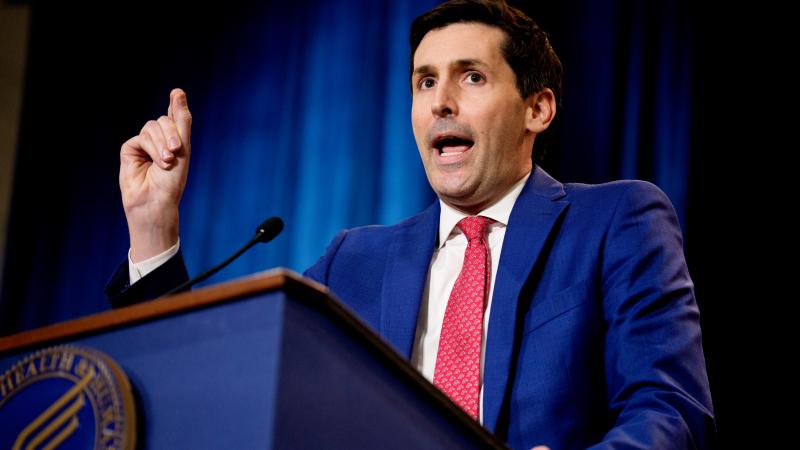
The head of the National Institutes of Health is now at the helm of a sub-agency, the Centers for Disease Control and Prevention. Dr. Jay Bhattacharya says President Trump personally asked him to take the CDC job temporarily until a permanent director can be named.
“It's hard to say ‘no’ to the president. What it means is that I will still be the director of the NIH. That's my main day job,” Bhattacharya told "Full Measure" in a recent interview at NIH headquarters in Bethesda, Maryland. “But over the next couple of months, I'm gonna go work with folks at the CDC to help get the agency in a place where the new director, whoever ends up being Senate confirmed, we'll have an organization that's running well so that they can get their priorities in place.”
Prior to the COVID-19 pandemic, Bhattacharya was a medical doctor and professor at Stanford University, “happily publishing in journals.” But during Covid, he became a very vocal opponent – for scientific reasons – for government-mandated lockdowns to try to stop the spread of the virus.
“I did a bunch of research that suggested that the lockdowns were not helping people, in fact, were causing tremendous harm to the poor children in the working class, all the school closures and all that,” he says.
Bhattacharya helped create and get thousands of signatures on the Great Barrington Declaration to speak out against the lockdowns on public health grounds. For that, he became a target of the head of NIH at the time, Dr. Frances Collins, and Dr. Anthony Fauci, who headed the NIH Institute of Allergy and Infectious Diseases.
It was later revealed that the two men orchestrated a “devastating take-down” of Dr. Bhattacharya and his colleagues to silence and discredit them.
Today, it’s a stunning reversal of fortunes for Dr. Bhattacharya that he was chosen to head up the very agency whose leaders had conspired against him.
Bhattacharya says one of his main goals is to remove politics and ideology from science to "leave a lot more space for actual science.”
“The cultural shift is, is enormous,” he says.
“The purpose and the mission of the NIH is to do research that improves the health and longevity of the American people," Bhattacharya said. "First of all, everyone should be behind that mission. And then second, once you say that's the mission, that we're only gonna be focused on the mission, it frees you up from all of the baggage.
"You don't have to worry about looking over your shoulder, that you aren't ideologically pure enough. You just focus on science that can translate over to solving the longevity problems that the United States has, the chronic disease problems, the real problems.”
Establishment medicine figures who were frequently proved wrong about approaches to Covid and matters of Covid vaccine safety and effectiveness criticize most every decision and move Bhattacharya now makes.
He says in response to the criticism: “If the NIH’s mission is to do support research that translates into better health and longer life for Americans, well, the NIH over the last 15 years has failed in its mission.
"And so the idea that it's anti-science or politicizing the agency to remove political agendas from the agency, it's almost Orwellian. And so when I see these stories, my general understanding of them is that it's people that benefited from the old system where the focus was in part on ideology.”
Bhattacharya says part of the steps to remove politics from the NIH is to begin a new plan to genuinely study vaccine injuries and treatments.
“We're working on that,” he told "Full Measure." “One of the things that Tony Fauci’s old NIAID is gonna be doing is studying vaccine injury.”
For more on this story, watch "Full Measure with Sharyl Attkisson” Sunday. Attkisson's most recent book is "Follow the $cience: How Big Pharma Misleads, Obscures, and Prevails."
The Facts Inside Our Reporter's Notebook
Links


Top Stories



Trending
Just the News Spotlight
Just News, No Noise