Related Articles
The new memos declassified by Tulsi Gabbard were not available to the public during the 2019 impeachment trial.
The U.S. intelligence watchdog developed derogatory evidence about the CIA analyst who prompted the 2019 Ukraine-focused impeachment against Donald Trump, including that he submitted false information in his whistleblower complaint, offered hearsay to support his allegations and had the "potential for bias," according to newly declassified memos that were kept from Americans during the failed bid by Democrats to remove the president from office six years ago.
The documents declassified by Director of National Intelligence Tulsi Gabbard at the request of Just the News provide a starkly different portrait of the alleged whistleblower whose name and face were never shown to the public and whose lawyerly written letter accusing Trump of hijacking Ukraine policy for political gain was heralded by Democrats to launch impeachment proceedings.
Investigators for the Intelligence Community Inspector General documented several concerns about the Trump accuser's political motives, noting he admitted he was a "registered Democrat" who had worked closely with Joe Biden on Ukraine issues and who disliked some of the conservative figures in the president's orbit, the memos show.
The investigators also elicited an apology from the Trump accuser for misleading the probe and were acutely aware his allegations were based solely on second- and third-hand accounts about what Trump was alleged to have said and done.
“I do not have direct knowledge of private comments or communications by the President,” the alleged whistleblower, who claimed Trump improperly tried to pressure Ukraine President Volodymyr Zelenskyy to investigate Hunter Biden, admitted in his initial August 2019 intake form.
That stunning line on the limitations of the whistleblower's knowledge was not included in the nine-page letter then-House Intelligence Committee Chairman Adam Schiff, D-Calif., released in late summer 2019 that touched off a months-long political maelstrom and led to Trump's impeachment by a Democrat-led House and his eventual acquittal in the Senate.
You can read the documents here:
Defense lawyers for Trump as well as some members of Congress who served as impeachment managers told Just the News they were deeply concerned the derogatory evidence about Trump's accuser was kept classified by then-Inspector General Michael Atkinson and Schiff, preventing it from being used to defend the president or conduct impartial proceedings in the House and Senate.
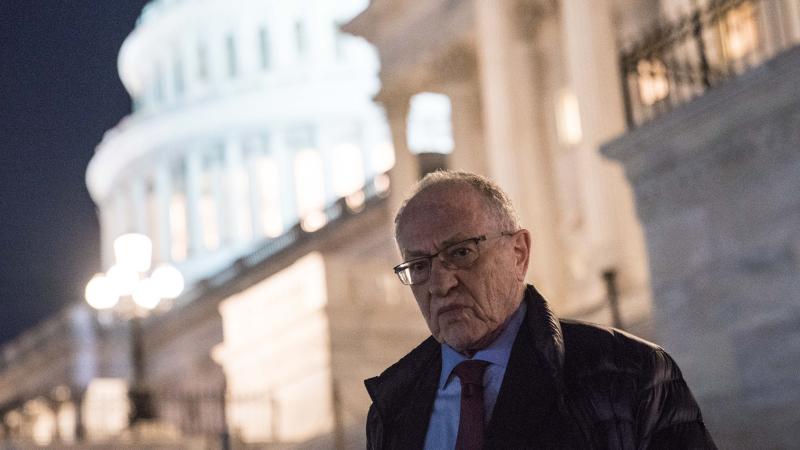
"Our adversarial system of justice requires the government to turn all exculpatory evidence over to the accused. That’s especially true when lawmakers seek to remove a duly elected president through impeachment and a Senate trial," said famed Harvard law professor emeritus Alan Dershowitz, one of Trump's defense lawyers in the case.
"The evidence about the bias and credibility of the whistleblower who started the scandal should have been front and center in the 2019 impeachment, but it was hidden by bureaucrats and that was a disservice to justice and to the American people," Dershowitz said.
Mark Meadows, who as a North Carolina congressman served as an impeachment manager defending Trump before becoming his White House chief of staff, said GOP lawmakers during the impeachment had serious concerns about the alleged whistleblower and were "questioning his credibility and truthfulness.
"The exaggerated pushback and concern from Chairman Adam Schiff made many Republicans members think that there was much more of a coordinated propaganda effort than seeking the truth in any potential wrongdoing," Meadows said. "Democrats leaked everything from the secure deposition room except the fact that they were coordinating with a 'so called' whistleblower who had no first-hand knowledge of the subject."
The memos also disclose numerous other details about the whistleblower and the intelligence community's assessment of his claims that weren't available to the public, including that the CIA analyst:
Appeared interested in thwarting then-Attorney General Bill Barr from probing Hunter Biden, even though Barr wasn't a member of the intelligence community covered by the complaint;
Disliked Republicans around Trump, including former House Intelligence Committee Chairman Devin Nunes and current FBI Director Kash Patel. The documents show the alleged whistleblower even went so far as to make a “request for Nunes not to view the disclosure" as a member of Congress even though he was a member of the "Gang of Eight" leadership entitled to see such intelligence;
Impugned then-top Trump National Security Council staffer Michael Ellis, now the deputy CIA director, as "slippery and untrustworthy" during a voluntary interview;
Claimed he was a victim of an intimidation campaign carried out by "right-wing bloggers"; and
Worked on his whistleblower complaint with a witness whose name was redacted and who told investigators he was connected to Peter Strzok, the former FBI agent who was fired in 2019 for his role in leading the now-discredited Russia collusion probe.
Such spontaneous statements during the early intelligence community's review of the whistleblower complaint led the inspector general's agents to raise red flags about the complaining CIA officer's possible political bias.
While Atkinson kept the memos secret, he did grant a closed-door classified interview to lawmakers during the leadup to the House impeachment proceedings. The House Intelligence Committee is expected to release the transcript of that interview as early as this week.
Nunes, who was still in Congress during the impeachment and now serves as the chairman of the President's Intelligence Advisory Board, told Just the News the impeachment process was a "shocking and shameful chapter in our history" and the new memos "further demonstrate the highly orchestrated way the fake whistleblower manufactured and deployed his complaint.
"It was clearly a staged attack by anti-Trump malcontents in the intelligence bureaucracy who believed that they, not the American people, should determine who is the U.S. president," Nunes said. "The Democrats and the media promoted this hoax as a desperate Plan B after their original pretext for impeaching Trump - Russian collusion - finally collapsed following Special Counsel Mueller's inept testimony to Congress."
Even supporters of the alleged whisteblower had concerns, the memos show. The official identified only as “Witness 2” disclosed that even though he came to vouch for and support the whistleblower, he had his own concerns about the allegations and would not have made such allegations based on what he knew.
"Witness 2 made it clear that [Redacted] would not have taken independent action on the information [Redacted] read in the transcript for two reasons: first that [Redacted] routinely deals with issues on a daily basis that are contrary to [Redacted] personal beliefs; and second that [Redacted] did not have the level of granular insight of details related to the Ukraine that Complainant had,” the memo said. “Witness 2 could not connect the same dots that Complainant did into the impact of what was said during the telephone call.”
That same witness acknowledged that before he supported the whistleblower, he had worked on a controversial December 2016 intelligence community assessment that claimed Vladimir Putin tried to help Trump beat Hillary Clinton in that year’s presidential race, a conclusion that the CIA now admits was based on faulty intelligence and poorly executed spy tradecraft.
The alleged whistleblower's name was redacted from the newly declassified memos but has been identified in some media reports as retired CIA analyst Eric Ciaramella, who now works at a D.C. think tank and is a regular on a podcast critical of Trump policies.
Officials declined to publicly confirm whether Ciaramella was, in fact, the whistleblower when questioned by Just the News.
Ciaramella has appeared on numerous podcast episodes put out by the anti-Trump Lawfare outlet. Benjamin Wittes, the editor-in-chief of Lawfare, appeared on multiple episodes with Ciaramella. Wittes was described by Politico in 2017 as “The Bard of the Deep State” and is a longtime Trump critic and a self-described friend of fired FBI Director James Comey and Strzok.
Ciaramella did not respond to a request for comment sent to him through the Carnegie Endowment for International Peace, where he is listed as the Ukraine Initiative Director for the Russia and Eurasia Program.
The memos' most explosive revelation shows the alleged whistleblower was caught early on by the Intelligence Community Inspector General — the independent watchdog for U.S. spy agencies — falsely claiming he did not have contact with Congressional Democrats about his Trump-Ukraine allegations.
When evidence emerged in media reports that he had indeed had prior contact with Democrats on the House Intelligence Committee, the alleged whistleblower admitted he had omitted that information in his initial contacts with the IG and offered an apology, something never disclosed to the public.
The “Disclosure of Urgent Concern Form” submitted by the whistleblower on August 13, 2019, included answering a section titled, “I have previously disclosed (or am disclosing) the violations alleged here to (complete all that apply).”
He checked a box next to “other office of department/agency involved” and said he had already spoken with the CIA Office of General Counsel, the CIA's Election Security Mission Manager, the National Intelligence Officer for Russia, and the Chair and Vice Chair of the National Intelligence Council.
But he did not check “Congress or congressional committee(s)” despite having spoken with the staff of then-Congressman and now-Sen. Schiff before submitting his disclosure.
Schiff told MSNBC in September 2019 that “we have not spoken directly with the whistleblower” — even though members of his staff already had.
“We would like to, but I’m sure the whistleblower has concerns, that he has not been advised, as the law requires, by the inspector general or the director of national intelligence just as to how he is to communicate with Congress, and so the risk to the whistleblower is retaliation,” Schiff added.
A Schiff spokesperson soon told Fox News in October 2019 that Schiff himself "does not know the identity of the whistleblower, and has not met with or spoken with the whistleblower or their counsel" for any reason. An aide to Schiff claimed to the outlet that when Schiff had contended that "we" had not spoken to the whistleblower, he was allegedly referring to members of the full House intelligence committee, rather than referencing staff.
The Democrat-led House Intelligence Committee spokesman at the time, Patrick Boland, argued to CNN that it was a “regular occurrence” for a whistleblower to reach out to the committee for help and said that the Schiff staff “appropriately advised” the whistleblower.
“Like other whistleblowers have done before and since under Republican and Democratic-controlled committees, the whistleblower contacted the committee for guidance on how to report possible wrongdoing within the jurisdiction of the intelligence community,” Boland told The New York Times that month. “At no point did the committee review or receive the complaint in advance.”
The newly declassified memos show the alleged whistleblower spoke with then-Intelligence Community Inspector General Michael Atkinson on October 8, 2019, where he admitted that he had spoken with Schiff staff beforehand yet had not checked the proper box, with the whistleblower both defending his actions and apologizing.
“ln regard to the news reports and questions regarding how the Office of the Inspector General of the Intelligence Community Hotline forms were completed, and specifically that Complainant did not check that he/she had reported the matter to Intelligence Committees as had been reported in the news, was because no substance was given to the Intelligence Committees,” one memo of recounted.
“Complainant did not feel it was necessary to check that particular box because he/she had not provided any substantive information. His/her questions were only procedural in nature, asking how to submit the concern,” the memo continued. “The person Complainant asked told him/her to, 'Do it right, hire a lawyer, and contact the ICIG.' So, that is what the Complainant did. At the time, Complainant did not even know what the ICIG was.”
The memo added: “Based on getting guidance on a procedural question, and that no substance of the actual disclosure was discussed, Complainant did not feel, based on the way the form question was worded, that it was necessary to check that box. Complainant advised he/she was sorry for any problems caused for Mr. Atkinson due to the way he/she answered that question, as it was certainly not his/her intent.”
After the House impeached Trump in December 2019 and before the Senate trial began in early 2020, some members of Congress began to question whether the alleged whistleblower was politically biased and Real Clear Investigations raised the possibility there was classified evidence he had misled Atkinson.
But Trump's lawyers were never allowed to introduce the ICiG evidence at trial because it was kept classified, keeping potentially exculpatory evidence of bias and credibility from the public and the Senate jurors.
The Intelligence Community Inspector General’s “Memorandum of Investigative Activity” related to the watchdog’s August 20, 2019, interview of the alleged whistleblower included a section on the "potential for bias" — although he insisted his complaint was free from political influence.
“ICIG interviewing officials asked Complainant what information there might be as evidence of Complainant's potential bias against President Trump,” the memo said. “Complainant listed three potential ways people might allege bias though [Redacted] is certain disclosure is free from political influence.”
The memo continued: “First, Complainant worked closely with Vice President Biden as an expert on Ukraine. [Redacted] traveled with Biden to Ukraine and was part of conversations where [Ukrainian Prosecutor General Yuriy] Lutsenko corruption was discussed.”
The alleged whistleblower was also a listed guest of then-Vice President Biden at a luncheon in October 2016 to honor the prime minister of Italy. Biden co-hosted the banquet with former Secretary of State John Kerry for then-Italian Prime Minister Matteo Renzi. The alleged whistle-blower was among the U.S. officials who accepted an invitation.
The alleged whistleblower also told the intelligence community watchdog in August 2019 that “second, Complainant worked for the President Trump White House for [Redacted] as an [Redacted] was then asked by [Redacted] to be [Redacted]. Complainant said this was a very stressful job and [Redacted] became the target of right-wing bloggers, such as [Redacted], and conspiracy theorists.”
The August 2019 memo’s section on the alleged whistleblower's potential bias also added that “finally, Complainant is a registered Democrat.”
Atkinson, the intelligence community watchdog, wrote in August 26, 2019 that “although the ICIG’s preliminary review identified some indicia of an arguable political bias on the part of the Complainant in favor of a rival political candidate, such evidence did not change my determination that the complaint relating to the urgent concern ‘appears credible,’ particularly given the other information the ICIG obtained during its preliminary review.”
The newly-declassified memos indicate the reference to "arguable political bias" prompted thhe alleged whistleblower to reach back out to the intelligence community watchdog’s investigators.
“On September 26, 2019, at approximately 8:45 a.m., Complainant contacted writer via secure line,” the memo says. “Complainant had concerns over wording in letter from ICIG to DNI Maguire, specific to ‘indicia of arguable political bias.’ Complainant expressed concern that he/she had someone indicated to writer during interview of support for a particular political candidate, which would not have been correct or intentional.”
The intelligence official dubbed “Witness 2” — an ally of the alleged whistleblower during the Ukraine saga — spoke with the ICIG on August 21, 2019. At the time, “Witness 2” was a member of the NSC whose home agency was the National Security Agency, and he was working for the Directorate of Intelligence and for the European and Russian Affairs Directorate.
“Witness 2 reviewed the transcript [of the call between Trump and Zelenskyy] in order to have situational awareness of the circumstances surrounding the call, and the discussions of the call, as he was covering for the Director of Ukraine, hereafter referred to as (‘Alex’), while Alex was out of the office,” the memo said.
The memo said that “Witness 2 worked with Peter Strozk [sic], and Witness 2 knew how it would play out if [Redacted] said anything,” as the intelligence community watchdog quoted him saying that “if I unilaterally try to make an issue out of it, the only person impacted is me and not for the better.”
Strzok was a key player throughout the FBI’s deeply flawed Crossfire Hurricane investigation — including writing the opening communication that launched the inquiry. His text messages with then-FBI lawyer Lisa Page in 2016 repeatedly displayed anti-Trump sentiment.
“Witness 2 is assisting Complainant in regard to the urgent concern because Witness 2 wants to be able to sleep at night, and [Redacted] wants to help Complainant sleep at night, by registering how concerning this whole thing was,” the memo said. “Witness 2” stated that he “feels a moral and patriotic duty to help Complainant due [sic] what is right” and said that he wanted to “sleep the sleep of the just.'’
Despite this, “Witness 2” said he would not have done what the alleged whistleblower had done.
In a section on “Potential for Biases or to Be Discredited” it was also revealed that “Witness 2” had helped with the 2016 ICA on alleged Russian election meddling.
“If someone were to try to discredit information provided by Witness 2, they might focus on Witness 2 being the co-author of the 2017 ICA (Intelligence Community Assessment) on Russian Interference in the 2016 election,” the memo said, adding that “the ICA could have been, or could be looked at, as negative towards President Trump.”
The 2016 ICA was written at the direction of then-President Obama and largely overseen by Comey, former CIA Director John Brennan, and former Director of National Intelligence James Clapper.
Comey and former FBI Deputy Director Andrew McCabe had pushed in December 2016 to include Christopher Steele's debunked dossier in the 2016 ICA on alleged Russian meddling. The dossier was included in an annex to the assessment and was cited in the most highly-classified version of the ICA.
The House Intelligence Community report, declassified last year and the CIA review released last year, sharply criticized Brennan for allegedly joining with these anti-Trump forces in the FBI in pushing to include Steele’s baseless anti-Trump dossier in the ICA.
A declassified bombshell House Intelligence Committee report revealed that, despite repeated denials, the 2016 ICA on Russian election meddling pointed to the Steele Dossier when attempting to underpin the conclusion that Russian leader Vladimir Putin aspired to help Donald Trump win — with the ICA also allegedly ignoring evidence that the Russian leader may have favored (or at least fully expected) a Hillary Clinton victory instead.