Related Articles

President George W. Bush nominee claimed "heckler's veto doctrine" doesn't exist, told jury that censorship motivated by desire to "promote public order" doesn't violate First Amendment, appeals court hears.
A street preacher protested New York City's Pride celebrations five years ago with a sign reading "Fags and Whores Burn in Hell. Repent, Obey Jesus." Marchers responded by assaulting his group, captured on video.
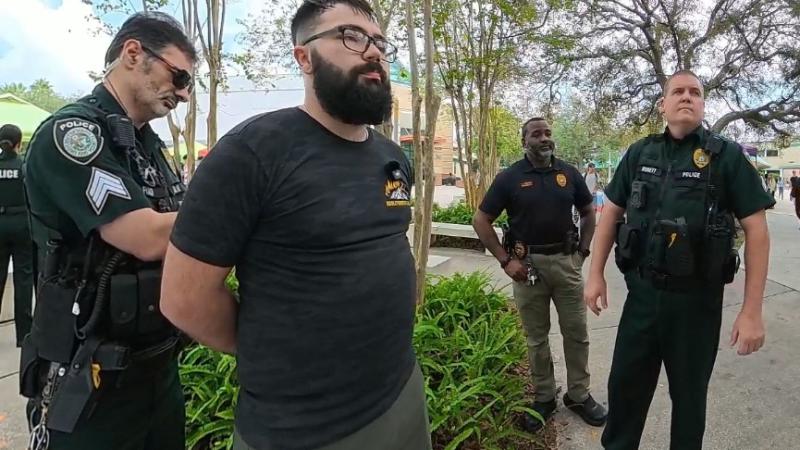
New York Police Department Assistant Chief Stephen Hughes responded by directing officers to arrest the evangelist for refusal to disperse after the assault.
The 2nd U.S. Circuit Court of Appeals is now considering whether Hughes imposed a heckler's veto on preacher Aden Rusfeldt and the jury received bad instructions that censorship motivated by a desire to "promote public order" does not violate the First Amendment.
The case has drawn almost no attention since Senior U.S. District Judge Kevin Castel, nominated by President George W. Bush, greenlit Rusfeldt's First and Fourth Amendment claims in 2024, noted at the time by First Amendment legal expert Eugene Volokh and New York Law School's civil litigation newsletter.
A jury cleared Hughes last summer by denying the 2021 arrest for refusal to disperse violated Rusfeldt's First or Fourth Amendment rights.
"Regulating a speaker due to listeners' reaction to his speech constitutes viewpoint discrimination as a matter of law, triggering strict scrutiny," the most demanding level of judicial review for governments to meet, Rusfeldt's lawyers at the Center for American Liberty said in his opening brief at the 2nd Circuit, which has yet to assign a three-judge panel.
"The heckler's veto doctrine applies even if the police are subjectively motivated solely by the intent to promote public order," said the group founded by Assistant Attorney General for Civil Rights Harmeet Dhillon.
Its brief cites the 1992 Supreme Court precedent Forsyth that forbade a Georgia county from considering "the likelihood of public hostility" to a courthouse protest against Martin Luther King Jr. Day when assessing permit fees for the protesters.
"The heckler’s veto cannot prevail in today’s politically polarized society" or else "the first group that resorts to violence will always win and make the First Amendment a nullity," the Liberty Justice Center said in a friend-of-the-court brief asking the 2nd Circuit to reverse the jury and enter judgment for Rusfeldt as a matter of law, as Rusfeldt unsuccessfully sought.
"Testimony from all officers showed that their priority was to prevent a violent event" and "they were indifferent to Rusfeldt’s speech," the libertarian group said.
Yet when Pride "participants were hurling objects and making violent threats" against Rusfeldt for "peacefully standing on the sidewalk displaying signs and vocalizing his message," cops arrested and removed him "to quiet the unruly mob."
LJC cited a bevy of Supreme Court precedents from 1917's Buchanan, which said "preservation of the public peace" must not come at the expense of constitutional rights, to 2017's Tam, which said viewpoint discrimination is especially dangerous when it targets ideas that "a particular audience might think offensive."
Ordered to leave because he's 'more cordial' than counter-protesters
"An order to disperse is lawful if its purpose is to promote public order and was not issued in a purely arbitrary manner," Judge Castel told jurors June 18 when they reconvened to reach a verdict in Rusfeldt's case, the transcript shows. "An order that is motivated by an intent to suppress or discriminate against a particular viewpoint is not a lawful order."
The judge had earlier claimed, while haggling with counsel for each party over the proposed jury instructions, that the 2nd Circuit affirmed his "promote public order" exception by upholding Castel's verdict in a 2011 bench trial after he refused to suppress evidence collected through an arrest for disorderly conduct that allegedly lacked probable cause.
"[T]hat's exactly where I got this concept" that "the strong suggestion" is a police order "is lawful if its purpose is to promote public order," said Castel, who as a senior judge hears a case load as little as 25% of a full-time judge.
During a sidebar after Castel finished the jury instructions, the judge refused a request Rusfeldt lawyer Joshua Dixon to change the instruction to "discriminating against the individual based on a crowd's response to that individual's speech constitutes discrimination based on viewpoint," based on the Forsyth precedent.
"Actually, that whole sentence is superfluous because I've said what a lawful order is," Castel snapped back at Dixon.
"Rusfeldt does not contend that the officers personally disapproved of his message," which is that "LGBTQ+ conduct is sinful and that God has called him to proclaim that message in public places," the Center for American Liberty's 2nd Circuit brief for Rusfeldt says.
"But the crowd did, and because the officers ordered him to disperse due to the crowd's reaction to his speech, the officers ratified the crowd's viewpoint discrimination against him as a matter of law," meaning Judge Castel should have ruled for him without a trial, it says.
The judge is flagrantly flouting Forsyth by denying there's even such a thing as a "heckler's veto doctrine," meaning Castel "never evaluated either whether the doctrine applies here or whether the NYPD satisfied strict scrutiny," and the police department waived the argument by never addressing the question, the brief says.
Even if it had, NYPD "indisputably" violated Rusfeldt's First Amendment rights as a matter of law by choosing "the option that was most restrictive" of his speech, rather than "setting up additional barricades, stationing additional officers on the scene, issuing warnings to the crowd not to break the law" or using its "ample resources to disperse the entire scene."
The brief emphasizes how many officers were on duty to protect the NYC Pride parade and affiliated events like PrideFest: 1,000 in Lower Manhattan, 400 of them stationed in the precinct that includes the site of Rusfeldt's protest, Washington Square Park, and 50 in the park itself. The 700-officer "Strategic Response Group" was also on standby.
"No permit covered the area where Rusfeldt's group was located," the brief says, calling out the elderly Castel for rejecting the motion for judgment as a matter of law by falsely claiming Rusfeldt was "located within the boundaries of Pridefest" several blocks away. The judge also falsely claimed the counterprotesters were covered by a permit.
"Rusfeldt and his companions," including his wife who recorded the video, "never blocked the sidewalk or road, and they were peaceful throughout," the brief says.
While the NYPD agreed from the start that Rusfeldt had violated no law by hoisting his inflammatory sign, officers ordered him to disperse after counter-protesters started throwing bottles at him, with video showing one cop telling the preacher they targeted him and not the crowd because Rusfeldt was "more cordial."
When Hughes arrived, he directed officers to threaten arrest if Rusfeldt didn't leave, at which point the preacher started moving away, prompting cheers from counter-protesters. But when Rusfeldt paused again and refused to move further away, Hughes had him arrested for "antagonizing" the counter-protesters with his sign, the brief says.